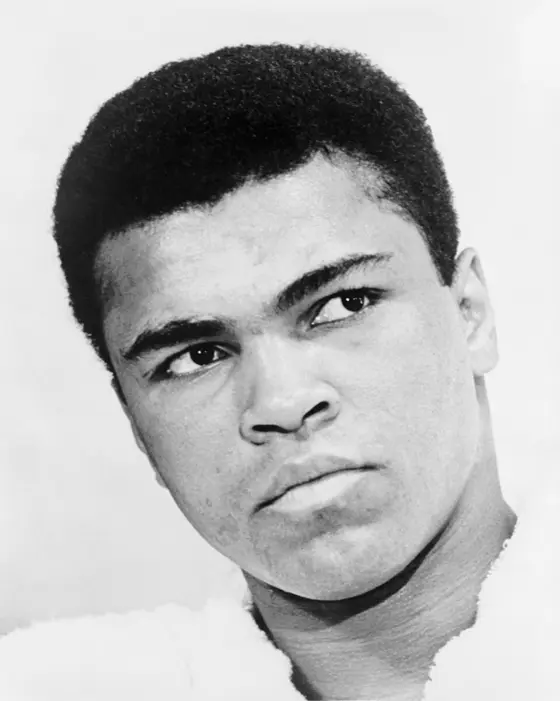
The Win, the Morning After, the Name
On February 25, 1964, at the Miami Beach Convention Hall, Cassius Clay was a 7-to-1 underdog against Sonny Liston. Liston was the heavyweight champion, widely regarded as unbeatable. Clay was 22 years old and had been loudly predicting victory for weeks in a way that most sportswriters treated as either showmanship or delusion. Liston did not answer the bell for Round 7. He sat on his stool and the fight was over. Clay was the heavyweight champion of the world.
The religious story came the next morning. On February 26, 1964, at a press conference, Clay confirmed what had been quietly circulating for months: he was a member of the Nation of Islam. "I don't have to be what you want me to be," he said. "I'm free to be what I want." The timing had been deliberate. He had feared that announcing his membership before the fight would get the bout cancelled.
Ten days later, on March 6, 1964, NOI leader Elijah Muhammad welcomed the new champion publicly and gave him the name Muhammad Ali. "Muhammad" means "worthy of all praise" in Arabic. "Ali" refers to one of the most revered figures in early Islamic history. The press, almost unanimously, kept writing "Cassius Clay."
Was He Actually Muslim in 1964? The Honest Answer
This question deserves a straight answer rather than a careful sidestep.
The Nation of Islam, founded in Detroit around 1930 by Wallace D. Fard and developed by Elijah Muhammad, holds beliefs that most mainstream Muslim scholars consider outside the boundaries of orthodox Islam. The NOI taught that Fard was "God in person," a claim that directly contradicts Tawhid, Islam's foundational principle of God's absolute oneness. Attributing divinity to any human being is considered shirk (idolatry) in orthodox Islamic theology. The NOI also taught a racial mythology in which white people were created by a rogue scientist named Yakub, a teaching with no basis in the Quran or Hadith. Traditional Islamic practice, including the Five Pillars and the hajj, was not standard NOI observance.
When Malcolm X broke with the NOI in 1964 and completed the hajj, he wrote from Mecca that praying alongside Muslims of every race had transformed his understanding of the faith. That transition, from NOI to Sunni Islam, is what many scholars mark as his actual conversion. Ali did not follow Malcolm in 1964. He stayed with Elijah Muhammad.
Ali's conversion to Sunni Islam came in 1975, when Elijah Muhammad died on February 25 of that year and his son Warith Deen Mohammed assumed leadership of the organization. Warith Deen dismantled the racial theology and directed the NOI toward mainstream Sunni practice. Ali followed him. He performed the hajj, observed the Five Pillars, and repudiated the racial mythology he had been taught. Around 2005, he adopted Sunni-Sufi practice after encountering the writings of Inayat Khan, a form of faith he maintained until his death in 2016.
The fair framing: Ali was unquestionably the first person publicly identifying as Muslim to hold the world heavyweight title. Whether NOI membership in 1964 constitutes Islam in the orthodox sense is a genuine theological dispute, not a settled question. The article that glosses over this does Ali no favors. His religious journey was more complex and more honest than a simple "converted in 1964" summary allows.
The Six-Year Battle Over a Name
The name Muhammad Ali was announced on March 6, 1964. Most American newspapers and broadcasters kept writing "Cassius Clay" for nearly six years.
A survey of seven major newspapers found 617 headline uses of "Clay" against 13 uses of "Ali" in 1964. In 1965, it was 389 to 10. The resistance was not simply habit. Editors made deliberate choices to refuse the name, often stating that "Cassius Clay" was his legal name and therefore the appropriate one to use. The argument had a surface reasonableness that obscured its actual function: using the old name was a way of refusing to acknowledge the identity he had claimed.
Howard Cosell was the exception in broadcasting. He began using "Muhammad Ali" immediately after the March 1964 announcement and kept doing so consistently. He received death threats for it. Cosell's position was simple: "He should be able to call himself whatever he wants."
The shift in the press happened around October 1970, when Ali returned to boxing after three and a half years of exile. By 1971, the seven surveyed newspapers used "Clay" in four headlines and "Ali" in 489. By 1972, "Cassius Clay" had disappeared from those papers' sports sections entirely. It took a Supreme Court case and a boxing comeback to make American newspapers print a man's name.
The Draft Refusal and Its Price
On April 28, 1967, in Houston, a military induction officer called Ali's name three times. He did not step forward.
His prepared statement: "I have searched my conscience and I cannot be true to my belief in my religion by accepting such a call."
The consequences were immediate and total. The New York State Athletic Commission suspended his boxing license that same day. The World Boxing Association stripped his title that same day. He had not lost a single fight since winning the championship in 1964. His title was taken without a defeat.
Ali had applied for conscientious objector status, arguing that as a minister in the Nation of Islam his religious beliefs forbade participation in wars not declared by Allah. The draft board denied it. The Justice Department's official position was that his objection was "political and racial" rather than religious. He was convicted of draft evasion on June 20, 1967, by an all-white jury that deliberated for 20 minutes. The sentence was five years in prison and a $10,000 fine. He stayed free on bail through appeals and never served prison time.
He did not box for three years and six months. He was 25 when he was banned and 28 when he returned. Those were, by common consensus, his peak athletic years.
Clay v. United States, 403 U.S. 698 (1971), reversed the conviction 8-0. (Thurgood Marshall recused himself due to his prior involvement with the Department of Justice.) The ruling was technically procedural: the government had failed to specify which of the three conscientious objector criteria it was rejecting, making the record ambiguous and the conviction legally defective. The Court did not rule that Ali deserved CO status as a matter of principle. But the practical effect was complete. The conviction was gone.
Three Title Reigns, One Record
Ali's first reign lasted from the Liston win in February 1964 until the draft refusal stripped him in April 1967. During those three years he defended the title against Liston in the controversial "phantom punch" rematch, Floyd Patterson, George Chuvalo, Henry Cooper, Brian London, Karl Mildenberger, Cleveland Williams, and Ernie Terrell. He won all of them.
The second reign began on October 30, 1974, at 4 a.m. in Kinshasa, Zaire, against George Foreman. Foreman was the undefeated champion who had knocked down Joe Frazier six times in two rounds. Ali was the 4-to-1 underdog. He leaned on the ropes for most of the fight, absorbing Foreman's punches while the champion exhausted himself, then knocked Foreman out in Round 8. It is the "rope-a-dope" strategy, one of the most famous tactical innovations in sports history. Less than a year later, on October 1, 1975, Ali fought Joe Frazier for the third time in Quezon City, Philippines, the Thrilla in Manila. Frazier's trainer stopped the fight before Round 15. Ali said afterward it was "the closest thing to dying that I know of."
He lost the second reign on February 15, 1978, when Leon Spinks, in only his eighth professional fight, beat him by split decision. Seven months later, on September 15, 1978, Ali defeated Spinks in the rematch by unanimous decision, becoming the only person in history to win the lineal heavyweight championship three times.
He retired in 1979. He came back in 1980 for a failed title challenge against Larry Holmes, stopped in Round 11. He fought once more in 1981 before retiring permanently. His final record: 56 wins, 5 losses, 37 knockouts.
The Long Fight After Boxing
Ali was diagnosed with Parkinson's disease in 1984, at age 42, three years after his final fight. Research published in JAMA Neurology in 2022 analyzed recordings of Ali's speech from age 26 onward and found his rate of syllables per second had slowed by 26 percent between age 26 and 39, with the decline starting in his early-to-mid 30s. The researchers, from the University of Florida's McKnight Brain Institute and Barrow Neurological Institute, concluded this was consistent with young-onset idiopathic Parkinson's disease with onset during the mid-phase of his boxing career. Whether repeated head trauma or idiopathic Parkinson's caused his condition remains debated in the medical literature, but the 2022 analysis found the presentation matched primary Parkinson's more closely than pugilistic parkinsonism.
In 1997, Ali partnered with neurologist Dr. Abraham Lieberman and philanthropist Jimmy Walker to establish the Muhammad Ali Parkinson Center at Barrow Neurological Institute in Phoenix, Arizona.
On July 19, 1996, at the Atlanta Olympics Opening Ceremony, Ali emerged from the shadows at the top of the stadium stairs to light the Olympic cauldron. The 80,000 people in attendance had not been told he was coming. They had watched swimmer Janet Evans carry the torch up the stairs and then, in the darkness above, a figure stepped forward. His hands were trembling from Parkinson's. He held the burning torch. The crowd began chanting: "Ali. Ali. Ali." It was, by every account, the most emotional moment of any Olympic ceremony in recent memory.
He died on June 3, 2016, in Scottsdale, Arizona, from septic shock, with Parkinson's disease as a contributing factor. He was 74 years old. He had lived with Parkinson's for 32 years. The original Atlanta Olympic torch has since been donated to the IOC museum.
Frequently Asked Questions
Who was the first Muslim world heavyweight boxing champion?
Muhammad Ali (born Cassius Marcellus Clay Jr.) became the first Muslim world heavyweight boxing champion on February 25, 1964, when he defeated Sonny Liston at the Miami Beach Convention Hall. Liston retired on his stool at the start of Round 7. Ali announced his Nation of Islam membership the following morning at a press conference.
Was Muhammad Ali actually Muslim in 1964, or was he in the Nation of Islam?
He was a member of the Nation of Islam. Most mainstream Muslim scholars consider the NOI's theology, particularly its claim that founder W.D. Fard was God in person, to be outside the boundaries of orthodox Islam. Ali converted to Sunni Islam in 1975, after Warith Deen Mohammed redirected the NOI following his father Elijah Muhammad's death. Ali later adopted Sunni-Sufi practice around 2005. He was unquestionably the first person publicly identifying as Muslim to hold the world heavyweight title; whether NOI membership constitutes Islam is a genuine theological question without a simple answer.
Why did Muhammad Ali refuse the Vietnam draft?
Ali refused induction on April 28, 1967, citing his religious beliefs as a minister in the Nation of Islam. He applied for conscientious objector status, which the draft board denied. His title was stripped the same day, without a fight. He was convicted of draft evasion, sentenced to five years in prison, and stayed free on bail. The Supreme Court reversed the conviction unanimously in Clay v. United States, 403 U.S. 698 (1971), on procedural grounds: the government had failed to specify which conscientious objector criteria his application failed to meet.
How many times did Muhammad Ali win the heavyweight title?
Three times, making him the only boxer ever to win the lineal heavyweight championship three times. First reign: February 25, 1964, defeated Sonny Liston; title stripped April 28, 1967 for draft refusal. Second reign: October 30, 1974, defeated George Foreman in the Rumble in the Jungle; lost to Leon Spinks February 15, 1978. Third reign: September 15, 1978, defeated Spinks in the rematch.
What was the "What's my name?" fight?
On February 6, 1967, Ali fought WBA heavyweight champion Ernie Terrell, who publicly refused to use Ali's Muslim name. Throughout their 15-round fight, which Ali won by unanimous decision, he repeatedly taunted Terrell with "What's my name?" while dominating the bout. Terrell later claimed he never heard anything Ali said during the fight. It remains one of the most politically charged fights in boxing history, a direct confrontation over whether Ali had the right to his own name.