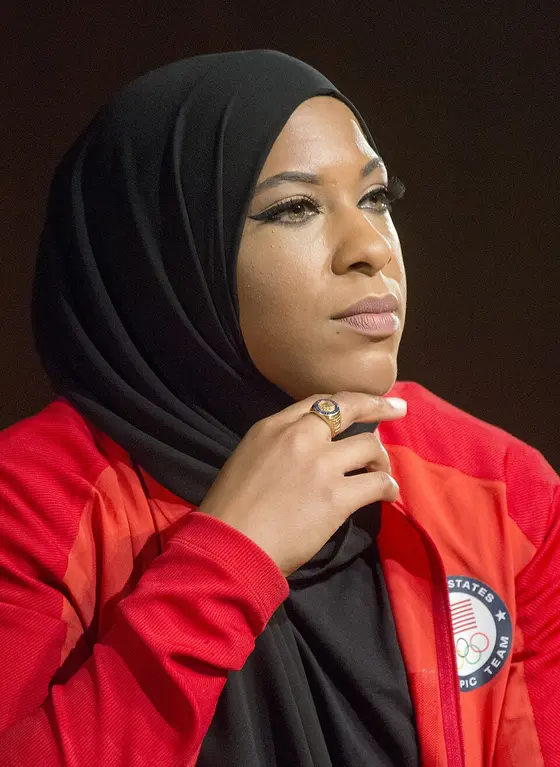
The Achievement
On August 8, 2016, Ibtihaj Muhammad stepped onto the piste at the Carioca Arena 3 in Rio de Janeiro for her first bout of the individual sabre event. She wore her hijab under her fencing mask, as she always had. In that moment, she became the first American athlete in Olympic history to compete while wearing a hijab.
Five days later, on August 13, she stood on the Olympic podium wearing a bronze medal. The US women's sabre team had defeated Italy 45-30 to claim third place. Muhammad became, in the same moment, the first Muslim American woman to win an Olympic medal and the first Black woman to win an Olympic medal in sabre.
Three firsts at once. None of them symbolic. She had earned two US national titles and five World Championship medals before she ever set foot in Rio.
Why Fencing: A Mother's Observation
The origin of Ibtihaj Muhammad's fencing career runs through a practical observation her mother, Denise, made when Ibtihaj was around 13 years old.
Ibtihaj had tried swimming, volleyball, tennis, and softball. Each sport created the same problem: the standard competitive uniform conflicted with Islamic dress requirements. Swimsuits, track shorts, gymnastics leotards, volleyball kits. Sports had been designed without Muslim women in mind, and the rules reflected that design.
Then Denise saw a group of young fencers at a school. She studied the uniform: a full-length jacket, knickers that fell below the knee, a glove, and a mask that covered the entire face and head. The standard fencing uniform, the one every competitor wore, already covered the whole body. No petition for an accommodation. No rule fight. No choice between faith and sport. A hijab fit naturally under the fencing mask, invisible to anyone watching.
That observation sent Ibtihaj Muhammad to the Peter Westbrook Foundation, a New York-based program founded by 1984 Olympic bronze medalist Peter Westbrook to bring fencing to underserved youth. The Foundation has produced multiple Olympians. For Muhammad, it provided access to elite coaching in a sport that was, and largely remains, overwhelmingly white and upper-income.
The Career Before Rio
A persistent misconception about Muhammad's 2016 Olympics story frames her selection as primarily symbolic. The record does not support that reading.
She attended Columbia High School in Maplewood, New Jersey, then earned an academic scholarship to Duke University, where she was a three-time All-American in fencing and graduated in 2007 with dual bachelor's degrees in international relations and African and African American Studies, along with a minor in Arabic.
She joined the US National Team and spent nearly a decade building one of the most decorated sabre careers in American fencing. Her major results before the 2016 Olympics:
- 2009 US National Champion, individual sabre
- 2011, 2012, 2013 World Championship team bronze medals
- 2014 World Championship team gold (the US women's sabre team)
- 2015 Pan American Games team gold
- 2015 World Championship team bronze
- 19 World Cup medals total
She qualified for Rio through results. The history she made there rested on a foundation of competition that had nothing to do with symbolism.
Rio 2016: What Actually Happened
The precise details of Muhammad's Olympic performance matter, because the most commonly repeated version of her story contains a significant error.
The 2016 Rio Games included two sabre events for women: individual and team. They are separate competitions with separate results.
In the individual sabre on August 8, Muhammad won her opening bout, defeating Olena Kravatska of Ukraine 15-13. She then lost in the round of 16 to France's Cecilia Berder, 15-12, finishing approximately 12th overall. She did not medal in the individual event.
The team sabre was a different story. The US women's sabre team, consisting of Muhammad, Mariel Zagunis, Dagmara Wozniak, and Monica Aksamit, advanced through the bracket and met Italy in the bronze medal match on August 13. The US won 45-30. Muhammad stood on the podium in her hijab alongside her teammates, and the image became one of the defining photographs of the 2016 Games.
Her bronze medal is a team bronze. The individual event ended in the round of 16. Both facts matter. The medal is real, but its context is specific: it came from a team competition, not an individual one.
A Note on the "First" Claim
Muhammad was the first American athlete to compete in hijab at the Olympics. That qualifier is not a hedge. It is the accurate framing, and every official source uses it consistently: Team USA's press release on August 8, 2016 reads "Ibtihaj Muhammad Officially Becomes First Team USA Athlete To Compete In Hijab At Olympics." The US Olympic and Paralympic Museum describes her as "the first Muslim American woman to win an Olympic medal."
The reason the qualifier matters: Muslim women from Muslim-majority countries had been competing at the Olympics for decades before 2016. At the same 2016 Rio Games, Egyptian beach volleyball player Doaa Elghobashy competed in hijab (wearing long sleeves, pants, and a headscarf instead of the standard bikini), making her the first to do so in beach volleyball at the Olympics. Two different athletes, two different countries, the same week. They were not competing for the same "first."
Muhammad's specific distinction is this: she was the first athlete representing the United States, a non-Muslim-majority country, to compete at the Olympics in hijab. Team USA had never before sent a competing athlete wearing one. That is the accurate and meaningful claim, and it is the one that should appear in any account of her story.
The Barbie and the Books
After Rio, Muhammad turned her platform toward reaching audiences that press coverage could not.
In November 2017, Mattel unveiled a Barbie doll in her likeness at the Glamour Women of the Year LIVE Summit in Brooklyn. It was the first Barbie in Mattel's history to wear a hijab. The doll wears a fencing uniform, carries a sabre and mask, and was added to Mattel's retail catalog (not just a one-off commemorative piece) when it went on sale in 2018. Muhammad worked directly with Mattel designers on how to style the hair under the hijab and how to tie the scarf correctly. It was part of the "Shero" line, a Mattel series honoring inspirational women.
For children encountering the idea that a Muslim woman in hijab can be an Olympic medalist, a Barbie is a more direct communication than any newspaper profile.
Her publishing work operates on the same principle but at two different reading levels. "Proud: My Fight for an Unlikely American Dream" (2018), written with Lori Tharps, is an adult memoir covering her childhood in Maplewood, her path through fencing, the racism and Islamophobia she navigated, the 2016 Olympics, and her work afterward. The New York Public Library named it a Best Book of 2018.
The children's series is a separate project entirely. "The Proudest Blue: A Story of Hijab and Family" (2019), illustrated by Hatem Aly, tells the story of a young girl whose older sister wears a hijab for the first time. It became a New York Times instant bestseller. Two sequels followed: "The Kindest Red: A Story of Hijab and Friendship" (2023) and "The Boldest White: A Story of Hijab and Community" (2024). The series addresses the experience of Muslim children in American schools, drawn directly from Muhammad's own childhood.
Beyond the Medal: Advocacy and Business
Two years before the Rio Olympics, in 2014, Muhammad co-founded Louella, a modest fashion clothing line, with her siblings. The brand targeted Muslim and other modest-dressing women in the American market, a segment that mainstream American fashion retail had largely ignored. Louella was operating on its own merits before Muhammad's Olympic profile amplified its reach.
After the Olympics, she served as a sports ambassador for the US State Department's Empowering Women and Girls Through Sport Initiative, traveling internationally to use athletics as a tool for diplomacy and women's empowerment. She described visiting countries where young Muslim girls had no female athletic role models in their own culture.
She also co-founded Athletes for Impact, connecting athletes with community change work.
Her last competition was the 2017 World Championships, where she won her second US national title. In August 2018, she made the Hajj pilgrimage to Mecca, which she described as transformational. She announced her retirement informally in 2019. She left on her own terms, with a second national title, more than a decade on the national team, and an Olympic medal.
Throughout, she has spoken publicly about anti-Muslim discrimination in the United States. She has described being detained and questioned by law enforcement while traveling despite her public profile as an Olympian. Her advocacy has consistently connected the specific question of hijab in sports to the broader experience of Muslim Americans in a post-9/11 country.
Frequently Asked Questions
Was Ibtihaj Muhammad the first Muslim woman to compete in hijab at the Olympics?
No. She was the first American athlete to compete in hijab at the Olympics, meaning the first to do so representing the United States. Muslim women from Muslim-majority countries had competed in hijab at the Olympics for decades before 2016. The "American" qualifier is critical and is the precise framing used by Team USA, the US Olympic and Paralympic Museum, and the Peter Westbrook Foundation in their official communications.
Did Ibtihaj Muhammad win an individual Olympic medal?
No. Her bronze medal came from the team sabre event on August 13, 2016, when the US defeated Italy 45-30. In the individual sabre event on August 8, 2016, she won her opening bout against Olena Kravatska of Ukraine 15-13 but lost in the round of 16 to France's Cecilia Berder 15-12, finishing approximately 12th.
Why did Ibtihaj Muhammad choose fencing?
Her mother, Denise, noticed a group of fencers and recognized that the standard fencing uniform already covered the entire body. No rule change or accommodation was needed for hijab. Fencing's mask, jacket, knickers, and glove covered everything, making it one of the only elite sports where Muhammad would never have to choose between her faith and competition. This is what led her to the Peter Westbrook Foundation and into the sport at around age 13.
What is the Ibtihaj Muhammad Barbie doll?
In November 2017, Mattel unveiled a Barbie doll in Muhammad's likeness as part of its "Shero" line honoring inspirational women. It was the first Barbie in Mattel's history to wear a hijab. The doll wears a fencing uniform with a sabre and fencing mask. It was announced at the Glamour Women of the Year LIVE Summit in Brooklyn and went on sale in 2018.
What books has Ibtihaj Muhammad written?
Muhammad has written two distinct series. "Proud: My Fight for an Unlikely American Dream" (2018), written with Lori Tharps, is an adult memoir covering her childhood, fencing career, the 2016 Olympics, and her advocacy work. Separately, she launched a children's picture book series starting with "The Proudest Blue: A Story of Hijab and Family" (2019), illustrated by Hatem Aly, which became a New York Times instant bestseller. The series continued with "The Kindest Red" (2023) and "The Boldest White" (2024). These are two different projects for two different audiences.