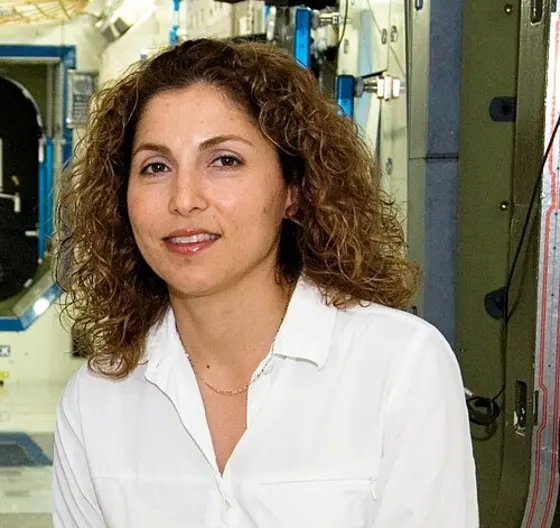
The Achievement
On September 18, 2006, Anousheh Ansari launched aboard Soyuz TMA-9 from Baikonur Cosmodrome in Kazakhstan, becoming the first Muslim woman in space, the first person of Iranian descent in space, and the first female self-funded spaceflight participant in history. She docked with the International Space Station two days later, spent approximately 8 days aboard the station conducting scientific experiments for the European Space Agency, and landed on the steppes of Kazakhstan on September 29. Total time in space: 11 days.
She was 39 years old. She had left Iran at 17 with no English. She had built and sold a telecom company for roughly $440 million. She had put her family's name on a prize that created the commercial space industry. And then, 22 years after arriving in the United States as a teenager with a dream formed by watching stars over Mashhad, she went there herself.
There is a detail that makes this story unusual among space firsts: she was not supposed to be on that flight. The original crew member for her seat was medically disqualified 28 days before launch. That she was ready to step in, having trained for six months as a backup, is part of what distinguishes her from the simplified "space tourist" label the press attached to her.
From Mashhad to Northern Virginia: The Immigrant Arc
Anousheh Ansari was born on September 12, 1966, in Mashhad, Iran, the country's second-largest city and a major center of Shia pilgrimage. Her childhood was shaped by the 1979 Islamic Revolution, which began when she was 12. She has described hiding with neighbors in apartment basements during unrest, and calming younger children by telling them stories during those periods. Those years left a mark, but not the one you might expect. In interviews she credits them with instilling the resilience that carried her through the harder phases of building companies and training for space.
She immigrated to the United States in 1984 at age 17, settling in Northern Virginia. She attended Lake Braddock Secondary School in Burke, Virginia, not speaking English when she arrived. She then enrolled at George Mason University in Fairfax and earned a BS in electronics and computer engineering, followed by an MS in electrical engineering from George Washington University. She later received honorary doctorates from George Mason, Utah Valley University, and International Space University.
The dream of space was not a later addition to her story. She has said she made a promise to herself as a teenager in Iran, looking up at stars, that she would find a way to reach them. The path turned out to run through Richardson, Texas, and a telecom company that nobody in 1993 would have predicted would end with its founder in orbit.
Building Telecom Technologies: The Money Behind the Mission
In 1993, Ansari co-founded Telecom Technologies Inc. with her husband Hamid Ansari and her brother-in-law Amir Ansari. Based in Richardson, Texas, the company built next-generation softswitch solutions for the telecommunications industry, founded with personal savings and retirement accounts when no institutional capital was willing to back them.
US telecom deregulation in the 1990s opened the market Telecom Technologies had built for. By 2001, Sonus Networks, a publicly traded carrier-grade voice-over-IP company, acquired Telecom Technologies in a stock deal in which Sonus issued 10.8 million shares. Reporting from EE Times valued the transaction at approximately $440 million. Anousheh Ansari became General Manager and VP of the resulting Sonus division. The roughly 220 Telecom Technologies employees formed Sonus's new INtelligentIP division and remained in Richardson. She held three US patents from this period.
The exit was significant not just as financial success, but as the source of capital that made everything that followed possible: the X Prize donation, the spaceflight seat, and ultimately the creation of the commercial space industry she had helped fund before she set foot in it.
The Ansari X Prize: Funding the Industry Before Joining It
In 2002, Anousheh Ansari and her brother-in-law Amir Ansari made a multimillion-dollar contribution to the X Prize Foundation, which had been founded in 1994 by Peter Diamandis to offer a $10 million cash award to the first private team to launch a reusable crewed spacecraft to 100 kilometers altitude (the Karman Line, the internationally recognized edge of space) twice within two weeks. The Ansari family's cumulative donations brought the prize fund to the full $10 million target. On May 6, 2004, the prize was formally renamed the Ansari X Prize in recognition of their contribution.
Five months later, on October 4, 2004, the 47th anniversary of the Sputnik 1 launch, SpaceShipOne completed its second qualifying flight and claimed the prize. Designed by Burt Rutan's Scaled Composites and financed by Microsoft co-founder Paul Allen, SpaceShipOne had flown to 100 kilometers altitude twice within a fourteen-day window. More than $100 million had been invested across the 26 competing teams pursuing the prize, a 10-to-1 return on the $10 million incentive.
The prize is widely credited with creating the conditions for Virgin Galactic, SpaceX's private crew missions, and Axiom Space. Ansari did not just benefit from commercial spaceflight. She helped fund the bet that proved it was possible, two years before she flew herself.
Twenty-Eight Days' Notice: How She Got the Seat
Ansari began training at Star City in early 2006, but not as the primary crew member for the Soyuz TMA-9 commercial seat. She was the backup, training behind Daisuke Enomoto, a Japanese internet entrepreneur who was the scheduled spaceflight participant for the mission. Training lasted approximately six months and covered Soyuz spacecraft systems, ISS systems, physical conditioning, emergency procedures, and Russian language study.
On August 21, 2006, Enomoto was medically disqualified. Space Adventures cited chronic kidney stones that he had not addressed aggressively enough. The following day, Ansari was elevated to prime crew status. Launch was scheduled for September 18. That left her 28 days to complete prime crew preparations.
She was ready. Six months of training as a backup, covering the same curriculum as the prime crew member, meant she was not starting from scratch. The 28 days were a compression of final preparations, not a scramble from the beginning. The distinction matters because it reflects something about her character: she had trained as if she were going to fly even when her role was to support someone else.
The Mission: Soyuz TMA-9
Soyuz TMA-9 launched from Baikonur Cosmodrome on September 18, 2006, at 04:59 UTC. The crew consisted of Commander Mikhail Tyurin (Russian Federal Space Agency, Expedition 14), Flight Engineer Michael Lopez-Alegria (NASA, Expedition 14), and spaceflight participant Anousheh Ansari. The spacecraft docked with the ISS on September 20.
Ansari spent approximately 8 days aboard the station. She did not return to Earth on Soyuz TMA-9, which remained docked at ISS for the Expedition 14 long-duration crew. Instead she returned on the older Soyuz TMA-8, which had been the transport for the outgoing Expedition 13 crew. TMA-8 landed on September 29, 2006, at 01:13 UTC, on the steppes of Kazakhstan approximately 90 kilometers north of Arkalyk, with crew members Jeffrey Williams (NASA) and Pavel Vinogradov (Russia) alongside Ansari. Total time in space: 11 days.
The $20 million seat price is the widely reported figure. Ansari's contract with Space Adventures prohibited exact disclosure, but it is consistent with what other Space Adventures clients paid for ISS visits in that period.
What She Actually Did Up There: Four ESA Experiments
Most coverage of Ansari's flight notes that she "conducted scientific experiments." The specifics are more interesting than that summary suggests, and they explain why the European Space Agency selected her as a research subject and data collector rather than treating her as a passenger.
The four experiments covered:
Neocytolysis: In weightlessness, the body selectively destroys young red blood cells, a process called neocytolysis, as an adaptive response to microgravity. The experiment studied this effect on the hematopoietic (blood-forming) system. Ansari provided blood samples before and after the flight. The data has downstream implications for understanding space anemia and for long-duration mission planning.
Chromosome radiation sensitivity: Cosmic radiation at orbital altitudes exposes crew to doses far higher than on Earth. This experiment examined chromosome changes and radiation sensitivity in lymphocytes, assessing the genetic impact of extended cosmic radiation exposure. It contributes to the risk modeling required for Mars mission planning.
Antibiotic resistance in microgravity: Some bacteria grow faster in weightlessness and show significantly elevated resistance to antibiotics. The experiment characterized these effects, which carry direct relevance to crew health on long-duration missions where medical resources are limited.
Muscle changes and lower back pain: A common complaint among astronauts is lower back pain. This experiment examined how microgravity-induced changes in spinal muscles contribute to that problem, with applications for both astronaut health and terrestrial spinal medicine.
Together these four areas represent real open questions in space medicine and physiology. The ESA was using Ansari's mission as an opportunity for data collection, not as a public relations exercise.
Blogging from Orbit: A First in Two Languages
Ansari became the first person to blog from the International Space Station. She published posts in both English and Farsi during her time aboard, making her also the first person to blog from space in the Farsi language. Her blog was accessible at spaceblog.xprize.org. She answered reader questions in real time from orbit and described her stated motivation as connecting with young people, particularly young women, about what spaceflight actually felt like.
The Farsi dimension of this is worth pausing on. Ansari's blog reached a generation of Iranian young women not through Western media accounts of an Iranian-American success story, but in their own language, transmitted from 400 kilometers above Earth, by someone who had grown up in the same country they lived in. She was also interviewed from space for an astronomy program on Iranian national television during the mission. The reach was extraordinary in a way that a press release or feature profile could never replicate.
After the Mission: XPRIZE and Continued Impact
Ansari did not treat the spaceflight as a capstone. In the same year as her mission she co-founded Prodea Systems, an Internet of Things technology company where she served as Chairman and CEO. Prodea earned recognition on Inc. Magazine's 500 fastest-growing companies list and Deloitte and Touche's Fast 500.
On October 18, 2018, she was appointed CEO of the XPRIZE Foundation at the organization's annual Visioneering event. As CEO she has overseen competitions spanning climate change, ocean health, artificial intelligence, and space exploration. The role brought her back to the organization whose prize she had helped fund 16 years earlier, this time as its leader.
Her other affiliations include UNESCO Goodwill Ambassador, member of the World Economic Forum's Global Future Council, life member of the Association of Space Explorers, and Fellow of the Aspen Global Leadership Network. Her awards include the Ellis Island Medal of Honor, the Horatio Alger Award, Ernst and Young Entrepreneur of the Year (Southwest Region), and the STEM Leadership Hall of Fame.
The 20th anniversary of her flight falls in September 2026. Commercial spaceflight has expanded far beyond what existed in 2006. Axiom Space, SpaceX Crew Dragon private missions, Virgin Galactic: the industry she helped fund with the Ansari X Prize has grown into something she could not have fully predicted. Her 2006 mission sits at the origin of that arc, before almost any of it existed.
Frequently Asked Questions
Who was the first Muslim woman in space?
Anousheh Ansari was the first Muslim woman in space. She launched aboard Soyuz TMA-9 on September 18, 2006, docked with the International Space Station on September 20, and returned to Earth on September 29, 2006, after 11 days total in space. She was also the first person of Iranian descent in space and the first female self-funded spaceflight participant.
How much did Anousheh Ansari pay to go to space?
Approximately $20 million, paid through Space Adventures, Ltd. Her contract prohibited disclosure of the exact amount. The $20 million figure is widely reported and consistent with what other Space Adventures clients paid for ISS visits during that period.
What experiments did Anousheh Ansari conduct in space?
Ansari conducted four experiments for the European Space Agency. They covered neocytolysis (destruction of young red blood cells in microgravity), chromosome changes from cosmic radiation exposure, antibiotic resistance in bacteria under weightlessness, and microgravity-induced muscle changes related to lower back pain. ESA treated her as a research subject and data collector, not a passive passenger.
What is the Ansari X Prize?
A $10 million competition to incentivize private spaceflight, formally renamed in May 2004 after Anousheh Ansari and her brother-in-law Amir Ansari made cumulative donations that funded the full prize amount. SpaceShipOne won it on October 4, 2004, by completing two crewed flights to 100 kilometers altitude within two weeks. The prize catalyzed more than $100 million in private space investment across 26 competing teams and is widely credited with creating the modern commercial spaceflight industry.
Was Anousheh Ansari originally scheduled to fly on Soyuz TMA-9?
No. She was initially the backup spaceflight participant, training behind Daisuke Enomoto, a Japanese entrepreneur who held the primary seat. On August 21, 2006, Enomoto was medically disqualified due to kidney stones. Ansari was elevated to prime crew status approximately 28 days before the September 18 launch. She was prepared because she had trained the full six-month curriculum as a backup, covering the same material as the primary crew member.