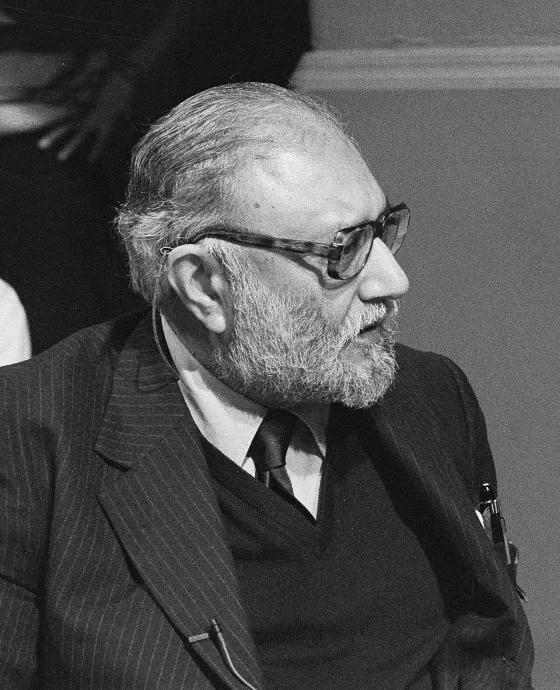
The Achievement
In October 1979, the Royal Swedish Academy of Sciences announced that Abdus Salam would share the Nobel Prize in Physics with Sheldon Lee Glashow and Steven Weinberg. The citation read: for their contributions to the theory of the unified weak and electromagnetic interaction between elementary particles, including the prediction of the weak neutral current.
The theory they were recognized for, electroweak theory, showed that two of nature's four fundamental forces are actually the same force in disguise. Electromagnetism and the weak nuclear force, which had appeared completely unrelated, are aspects of a single interaction that splits into two at the low energies of everyday physics. This insight became one of the central pillars of the Standard Model of particle physics, the most successful predictive framework in the history of science.
One distinction matters here and needs to be stated plainly. Salam was not the first Muslim to win any Nobel Prize. Egyptian President Anwar Sadat had won the Nobel Peace Prize in 1978, sharing it with Israeli Prime Minister Menachem Begin for the Camp David Accords. Sadat was the first Muslim Nobel laureate in any category. Salam, awarded the prize the following year, was the first Muslim to win in a science field. That is the specific record he holds.
Early Life
Muhammad Abdus Salam was born on January 29, 1926, in Jhang, a city in Punjab that was then part of British India. His father, Chaudhary Muhammad Hussain, was a school teacher in the Department of Education. The family were devout members of the Ahmadiyya Muslim Community, a sect founded in 1889 whose members believe in the prophethood of Mirza Ghulam Ahmad. That religious identity would shape the last decades of Salam's life more than almost anything else.
The first sign that Salam was exceptional came in his early teens. Around age 14, he sat the Punjab University matriculation examinations and recorded the highest marks in the history of that examination. The result was not just notable on paper. When he returned to Jhang, the entire town came out to receive him. The achievement mattered because it established what got Salam to England: not family money, but a track record that left institutions little room to ignore him.
He attended Government College Lahore for his undergraduate studies, then won a scholarship to St John's College, Cambridge. He completed the Mathematical Tripos in 1949 with a Double First-Class Honours in Mathematics and Physics. In 1950, Cambridge awarded him the Smith's Prize for the most outstanding pre-doctoral contribution to physics. His PhD in theoretical physics, on quantum electrodynamics, was completed in 1951.
Path to Electroweak Theory
After finishing his PhD in 1951, Salam returned to Pakistan. He took a teaching position at Government College Lahore, then became head of the Mathematics Department at the University of the Punjab in 1952. He had hoped to build a serious school of physics research.
He found this impossible. The academic environment offered minimal infrastructure for theoretical physics. Students were not oriented toward research. The government was not interested in supporting it. When Salam sought a meeting with the Minister of Education to raise the problem, the minister reportedly told him: "If it suits you, you may continue with your job; if not, you may go."
He later described this period as one of intellectual loneliness. In 1954, he left Pakistan for a lectureship at Cambridge, trading a professorship in his home country for a junior position in England. By 1957, he was appointed Professor of Theoretical Physics at Imperial College London, a position he would hold until 1993. He was 31.
The physics problem Salam turned his attention to was unification. By the mid-20th century, physicists had identified four fundamental forces: gravity, electromagnetism, the strong nuclear force, and the weak nuclear force. Electromagnetism was well understood. The weak force, responsible for certain types of radioactive decay (including the nuclear processes that make the sun shine), appeared to be an entirely different kind of phenomenon.
The unification of these two forces required several pieces. In 1961, Sheldon Glashow identified the mathematical symmetry group that could in principle describe both. His model had a critical flaw: it produced infinite quantities that could not be removed, and it required massless particles when experiments showed the force-carrying particles must be very heavy. In 1964, Peter Higgs and others proposed a mechanism by which particles could acquire mass while preserving the mathematical symmetry of the theory.
In 1964, Salam and physicist John Ward had independently identified the same symmetry group as Glashow, work that predated elements of the later synthesis. Then, in autumn 1967, Salam presented lectures at Imperial College in which he incorporated the Higgs mechanism into a complete, mathematically consistent unified theory. Steven Weinberg published essentially the same result in November 1967 in Physical Review Letters. The two had arrived at the same place independently and at nearly the same time. Salam's work appeared in a 1968 conference proceedings volume.
The Nobel Committee's decision to split the prize three ways reflects exactly that: Glashow laid the mathematical foundation, and Weinberg and Salam independently completed the theory. The independence of their parallel discoveries was precisely what made both worthy of recognition.
Experimental confirmation arrived in stages. In 1973, the Gargamelle experiment at CERN observed weak neutral currents, a new type of interaction the theory had predicted. In 1983, the W and Z bosons, the heavy particles that carry the weak force, were discovered at CERN by Carlo Rubbia and Simon van der Meer, who received the 1984 Nobel Prize for the discovery. The full framework was confirmed.
ICTP: Science Without Borders
The years in Pakistan had taught Salam what intellectual isolation costs. A scientist without colleagues, without journals, without the informal exchange of ideas that makes research possible, is not just inconvenienced. They are cut off from the field. Salam had escaped that isolation. Most scientists from developing countries never did.
In 1960, serving as a Pakistani delegate to the International Atomic Energy Agency, he formally proposed the creation of an international centre for theoretical physics. The idea was specific: scientists from the developing world could come to Trieste for weeks or months each year, work alongside leading physicists, access resources unavailable at home, and then return. Not emigrate permanently but return, renewing their connection to the field on a regular basis.
The IAEA agreed in 1963. The Italian government provided Trieste as the host city. In 1964, Salam and Italian physicist Paolo Budinich established the International Centre for Theoretical Physics. Over its history, ICTP has hosted more than 140,000 visits by scientists from 188 nations, approximately half from the developing world. Alumni have become professors, department heads, research directors, and science ministers across Africa, Asia, and Latin America.
One year after Salam's death, in November 1997, the institution was renamed the Abdus Salam International Centre for Theoretical Physics. It remains one of the most consequential scientific institutions ever created specifically to address the inequality in global access to research.
At the Nobel banquet in December 1979, Salam had stated: "The creation of Physics is the shared heritage of all mankind. East and West, North and South have equally participated in it." He donated his Nobel prize money to support physicists in developing countries.
The Ahmadiyya Question
The Ahmadiyya Muslim Community was founded in 1889 in Qadian, Punjab, by Mirza Ghulam Ahmad, who claimed to be the promised Messiah and a prophet. Mainstream Islamic scholars consider the claim of continued prophethood after Muhammad to be theologically disqualifying. The community has faced religious controversy throughout its existence, but in Pakistan, that controversy became state policy.
In September 1974, Pakistan's National Assembly passed a constitutional amendment under Prime Minister Zulfikar Ali Bhutto declaring Ahmadis to be non-Muslims for the purposes of Pakistani law. The vote was unanimous. Salam had served as Chief Scientific Adviser to the President of Pakistan since 1961. He resigned in protest after the amendment passed. He also, in a telling personal gesture, grew a beard and added "Muhammad" to his name, an affirmation of an identity the state had just revoked.
A decade later, on April 26, 1984, General Muhammad Zia-ul-Haq issued Ordinance XX, which went further. It prohibited Ahmadis from using Islamic terminology, calling themselves Muslims, or practicing in ways that could be construed as Islamic. Violation was a criminal offense. The leader of the Ahmadiyya community left Pakistan for London three days after the ordinance was issued.
Salam did not respond with public polemics. He continued his scientific work, continued his advocacy for developing-world science, and continued to identify himself as Muslim. At the Nobel Prize ceremony in Stockholm in December 1979, he wore traditional Pakistani and Ahmadi dress, a quiet statement of identity before an international audience.
He died on November 21, 1996, in Oxford, at the age of 70. The cause was progressive supranuclear palsy, a rare neurodegenerative disease affecting balance, eye movement, speech, and cognition. He had been ill for several years. At his request, his body was returned to Pakistan for burial in Rabwah (now officially named Chenab Nagar), the city that serves as the de facto headquarters of the Ahmadiyya community.
His tombstone was inscribed: "Abdus Salam, First Muslim Nobel Laureate." A local magistrate, citing Ordinance XX's prohibition on Ahmadis describing themselves as Muslims, ordered the word "Muslim" to be painted over. It was. The inscription now reads "First Nobel Laureate" with a visible blank where the erased word had been.
That image, the Nobel Prize winner's grave with a single word legally removed from his epitaph, became one of the most widely seen symbols of Pakistan's treatment of its Ahmadi minority. The tombstone stands in Rabwah as a document of two things simultaneously: a scientific achievement and a state's refusal to acknowledge the human being behind it.
Legacy
Salam's electroweak theory did not stop being important after the Nobel ceremony. It provided the precise mathematical framework from which the Higgs boson was predicted. When CERN announced the discovery of the Higgs boson on July 4, 2012, Salam's equations were embedded in every calculation that had pointed experimentalists toward what to look for and where. He had been dead for sixteen years. The Standard Model he helped build remains, as of 2026, the most successful predictive theory in the history of physics.
His record in the science Nobel Prizes has been added to since his death. Ahmed Zewail won the Chemistry Prize in 1999 for femtochemistry. Aziz Sancar won Chemistry in 2015 for work on DNA repair mechanisms. Moungi Bawendi, of Tunisian background, won Chemistry in 2023 for the synthesis of quantum dots. Salam remains the only Muslim Nobel laureate in physics.
In Pakistan, his recognition has been partial and inconsistent. In 2016, former Prime Minister Nawaz Sharif approved naming the National Centre for Physics at Quaid-i-Azam University in Islamabad after Salam, a measure of official rehabilitation. Streets and institutions carry his name. A 2018 documentary, "Salam: The First Nobel Laureate," brought renewed international attention to his story. The tombstone in Rabwah has not been restored.
This site uses Salam's own self-identification. He considered himself a Muslim. He said so at the highest-profile moment of his life. The state that declared otherwise produced no physics, founded no ICTP, and made no predictions that were confirmed by particle accelerators half a century later. The record belongs to Salam.
Frequently Asked Questions
Who was the first Muslim to win the Nobel Prize?
Anwar Sadat of Egypt won the Nobel Peace Prize in 1978, shared with Israeli Prime Minister Menachem Begin for the Camp David Accords. He was the first Muslim to receive any Nobel Prize. Abdus Salam won the Nobel Prize in Physics in 1979, making him the first Muslim to win in a science category (physics, chemistry, or medicine).
What did Abdus Salam win the Nobel Prize for?
Salam shared the 1979 Nobel Prize in Physics with Sheldon Lee Glashow and Steven Weinberg for electroweak unification, the theoretical framework showing that the electromagnetic force and the weak nuclear force are aspects of a single fundamental interaction. Glashow identified the underlying mathematical symmetry in 1961. Weinberg and Salam independently completed the theory in 1967-1968 by incorporating the Higgs mechanism, which resolved the mathematical inconsistencies in Glashow's original model.
Did Salam and Weinberg work together?
No. They worked independently and arrived at the same result at nearly the same time. Weinberg published in November 1967. Salam had given lectures with the same content at Imperial College in autumn 1967; his paper appeared in a 1968 conference volume. The simultaneous independent discovery was precisely what made both worthy of the prize, and the Nobel Committee recognized this by awarding it to both.
Why was the word "Muslim" erased from Salam's tombstone?
Salam was a member of the Ahmadiyya Muslim Community, which Pakistan's parliament declared legally non-Muslim in 1974. In 1984, Ordinance XX made it a criminal offense for Ahmadis to describe themselves as Muslims. After Salam's burial in Rabwah, a local magistrate cited that ordinance to order the word "Muslim" painted over on the inscription "First Muslim Nobel Laureate." The grave now reads "First Nobel Laureate" with a visible gap where the erased word had been.
What is ICTP and why did Salam found it?
The International Centre for Theoretical Physics in Trieste, Italy, was founded by Salam in 1964 to give scientists from developing countries regular access to the research infrastructure, colleagues, and resources they lacked at home. Salam's own years of scientific isolation in Pakistan in the early 1950s drove the idea. ICTP has hosted more than 140,000 visits from scientists across 188 nations. It was renamed the Abdus Salam ICTP in November 1997, one year after his death.
How many Muslim scientists have won Nobel Prizes?
As of 2026, four Muslims have won Nobel Prizes in the sciences: Abdus Salam (Physics, 1979), Ahmed Zewail (Chemistry, 1999), Aziz Sancar (Chemistry, 2015), and Moungi Bawendi (Chemistry, 2023). Salam remains the only Muslim Nobel laureate in physics.