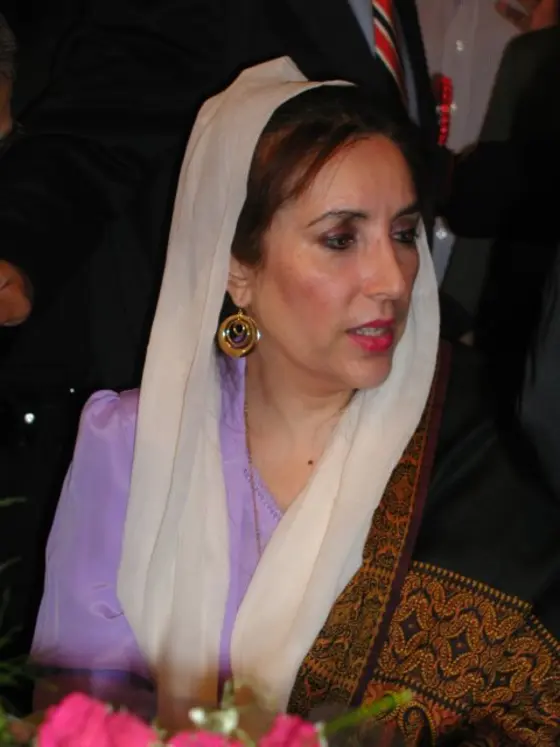
The Achievement
On December 2, 1988, Benazir Bhutto was sworn in as Prime Minister of Pakistan. She was 35 years old. She had given birth to her first child four months earlier and had spent much of the campaign visibly pregnant. She had also spent years in solitary confinement, years under house arrest, and years in exile. The religious establishment had issued fatwas arguing that Islam forbade a woman from leading a Muslim state. She had won anyway.
The precise framing of the record matters, and a site about historical firsts should state it plainly. Bhutto was the first woman elected to head a democratic government in a Muslim-majority country. Each word does work. Pakistan's population was approximately 97 percent Muslim. She won a general election, not an appointment or a succession. No woman had done that before in a Muslim-majority state. Encyclopaedia Britannica, Al Jazeera, and History.com all describe her in precisely those terms, and no credible historian disputes the claim.
The women who followed confirm rather than complicate her primacy. Khaleda Zia of Bangladesh won her first election in 1991, three years after Bhutto. Tansu Ciller became Prime Minister of Turkey in June 1993, described by Britannica as "the third woman to head a predominantly Muslim country." The ordering is uncontested: Bhutto first, Zia second, Ciller third.
Her Father's Hanging and What It Made Her
Benazir Bhutto was born on June 21, 1953, in Karachi, the eldest child of Zulfikar Ali Bhutto, one of Pakistan's most powerful politicians. She grew up in a household where politics was simply the air. Her father became Pakistan's elected Prime Minister in 1971. She attended the Convent of Jesus and Mary in Karachi before leaving Pakistan at 16 for Radcliffe College, the women's college affiliated with Harvard, where she majored in comparative government and graduated cum laude in 1973.
At Oxford she studied at Lady Margaret Hall, reading PPE before pursuing postgraduate work in international law and diplomacy. She also became the first Asian woman elected President of the Oxford Union, the debating society that has produced prime ministers across the Commonwealth. She returned to Pakistan in 1977 with plans to enter the foreign service. Within weeks, General Muhammad Zia-ul-Haq staged a coup and overthrew her father's government.
Zulfikar Ali Bhutto was arrested, tried on charges of authorizing the murder of a political opponent, and hanged on April 4, 1979. The trial was widely viewed internationally as politically motivated from the moment it began. In March 2024, Pakistan's own Supreme Court ruled that the trial had not met fair-trial standards, essentially confirming, decades after the fact, what Benazir had argued throughout her life.
The hanging transformed her. She spent the years between 1979 and 1984 cycling between house arrest and solitary confinement under Zia's martial law. She described being held in cells so hot she lost hair, and months confined without access to family. In late 1983, after a serious ear infection requiring surgery, she was released and allowed to travel to London for treatment. She did not return to Pakistan until April 1986, when crowds estimated in the hundreds of thousands met her in Lahore. Nine years of military rule and the PPP's support remained intact.
How She Won in 1988
Zia-ul-Haq died on August 17, 1988, when his military aircraft crashed under circumstances that were never fully explained. The U.S. ambassador and several senior Pakistani and American military officers also died in the crash. His death opened space for elections that his regime had long suppressed.
Pakistan held general elections on November 16, 1988. Bhutto's Pakistan People's Party won 94 of 207 National Assembly seats. The conservative Islamic Democratic Alliance, assembled by military intelligence specifically to oppose the PPP, won 56. With coalition support, the PPP formed a government.
The religious establishment's opposition was loud. Several clerics issued fatwas arguing that a woman could not lead a Muslim state. Bhutto's response was direct: she argued that nothing in the Quran prohibited women's leadership, that the Prophet's wife Khadijah had been a successful merchant and leader, and that those invoking religion against her were using it as a political instrument rather than a spiritual one. She had made this argument before and she kept making it after. Her 1995 speech in Beijing, quoted above, is the clearest statement of how she understood what her election had proved.
Two Terms, Both Cut Short
Bhutto's first government faced structural constraints from the start. The military, which had never accepted PPP rule, retained effective control of foreign policy, nuclear weapons, and Afghanistan policy. The ISI operated as a semi-autonomous power center. President Ghulam Ishaq Khan, a holdover from the Zia era, held constitutional power under the Eighth Amendment to dismiss the government without a parliamentary vote.
The first term produced modest but real accomplishments: five women appointed to cabinet (unprecedented at the time), restrictions on student and trade unions lifted, the Convention on the Rights of the Child signed, political prisoners released. On August 6, 1990, Khan dismissed Bhutto's government on charges of corruption, nepotism, and failure to maintain law and order. Elections held in October 1990 were later documented to have been rigged by intelligence services. Bhutto became Leader of the Opposition.
Nawaz Sharif's government fell in 1993 following a constitutional crisis. The PPP won the ensuing elections. Bhutto was sworn in for a second term on October 19, 1993. The second term was more troubled than the first. Her husband, Asif Ali Zardari, was appointed a minister with wide economic powers. He quickly acquired the nickname "Mr. Ten Percent" for alleged kickbacks on government contracts. A 1996 New York Times investigation estimated that Bhutto and Zardari extracted approximately $1.5 billion through corrupt dealings during her tenure. The corruption allegations, while politically weaponized by opponents, were not fabrications: Swiss courts later found against her in money laundering cases as well.
On November 5, 1996, President Farooq Leghari, a PPP loyalist whom Bhutto had helped install, dismissed her second government on charges of corruption, ruining the economy, undermining the judiciary, and sanctioning police hit squads. Her party lost decisively in the February 1997 elections. She left Pakistan in 1999 and would not return for eight years.
Return, Assassination, and What the End Proved
By 2007, General Pervez Musharraf's military government was under pressure from multiple directions. The United States, needing a civilian-democratic partner for continued engagement in Pakistan, brokered negotiations. On October 5, 2007, Musharraf issued the National Reconciliation Ordinance, granting amnesty to politicians for offenses between 1986 and 1999. The legal cases against Bhutto were wiped out.
She returned to Karachi on October 18, 2007. A suicide bombing hit her motorcade that evening near Karsaz, killing 139 people. She survived. She kept campaigning.
On December 27, 2007, following a rally at Liaquat National Bagh in Rawalpindi, she stood through her vehicle's sunroof to wave at supporters. Three shots were fired. A suicide bomb detonated. At least 23 others were killed at the scene. Bhutto was taken to Rawalpindi General Hospital and declared dead at 6:16 p.m. local time. She was 54.
A Scotland Yard investigation concluded she died from a skull fracture sustained when the blast knocked her back into the vehicle. Her family disputed this account. Pakistani and U.S. officials named Baitullah Mehsud, a Pakistani Taliban commander linked to al-Qaeda, as the organizer. A UN investigation in 2010 found that Pakistani government officials had "failed profoundly" in their duty to protect her. She was buried at her family's ancestral mausoleum in Garhi Khuda Bakhsh, Sindh, beside her father.
What the First Actually Meant
Bhutto's legacy is genuinely complicated, which is part of why it is worth taking seriously. She broke a barrier that her opponents insisted could not be broken, on grounds they called religious, and she answered those arguments not by distancing herself from Islam but by engaging them directly. Her Beijing speech in 1995 remains the clearest articulation of the argument: that the exclusion of women from Muslim political life was a social taboo dressed up as theology, not an Islamic commandment. Her election, she argued, gave Muslim women "moral strength to declare that it is socially correct for a woman to work."
At the same time, both of her governments were marked by documented corruption that went beyond political attacks. She was removed twice, by two different presidents, including one she had installed herself. The scale of what was extracted during her second term was reported in detail by international journalists, not invented by her enemies.
Holding both things at once is not a contradiction. It is the honest account. She opened something that had been closed, on terms that proved her central argument right: Islam was not the obstacle her opponents claimed it was. The obstacles were military power, institutional corruption, and the Eighth Amendment. Those are different problems, and they were real ones. The women who came after her, Khaleda Zia in 1991, Tansu Ciller in 1993, Sheikh Hasina in 1996, walked through a door she had opened in 1988. That part of the record stands without qualification.
Frequently Asked Questions
Who was the first woman to lead a Muslim-majority country?
Benazir Bhutto was the first woman elected to head a democratic government in a Muslim-majority country. She was sworn in as Prime Minister of Pakistan on December 2, 1988. The qualifier "elected" and "democratic government" is precise and intentional: it distinguishes her from anyone who may have held power through appointment, succession, or unelected means.
How many terms did Benazir Bhutto serve as Prime Minister?
Two non-consecutive terms. The first ran from December 2, 1988, to August 6, 1990, when President Ghulam Ishaq Khan dismissed her government. The second ran from October 19, 1993, to November 5, 1996, when President Farooq Leghari dismissed it. Neither term was completed in full. No Pakistani prime minister completed a full term until 2013.
What did Benazir Bhutto say about Islam and women's leadership?
Bhutto consistently argued that her election was not un-Islamic. At the Fourth World Conference on Women in Beijing in 1995, she said: "My election destroyed the myth built by social taboo that a woman's place is in the house. It gave women all over the Muslim world moral strength to declare that it is socially correct for a woman to work." She argued that clerics issuing fatwas against her were using religion as a political tool, not a spiritual one.
Who were the women leaders of Muslim-majority countries who followed Bhutto?
Khaleda Zia of Bangladesh won her first election in 1991, becoming the second woman elected to lead a Muslim-majority democracy. Tansu Ciller became Prime Minister of Turkey in June 1993; Encyclopaedia Britannica describes her as "the third woman to head a predominantly Muslim country." Sheikh Hasina of Bangladesh first became Prime Minister in 1996. The ordering is uncontested in reference sources.
How was Benazir Bhutto assassinated?
Bhutto was killed on December 27, 2007, in Rawalpindi. After a rally at Liaquat National Bagh, she stood through her vehicle's sunroof to wave at supporters. Three shots were fired, followed immediately by a suicide bomb that killed at least 23 others. A Scotland Yard investigation concluded she died from a skull fracture sustained when she fell back into the vehicle after the blast. Her family disputed this. Baitullah Mehsud, a Pakistani Taliban commander, was named as the organizer by Pakistani and U.S. officials. A 2010 UN investigation found Pakistani government officials had "failed profoundly" in their duty to protect her.