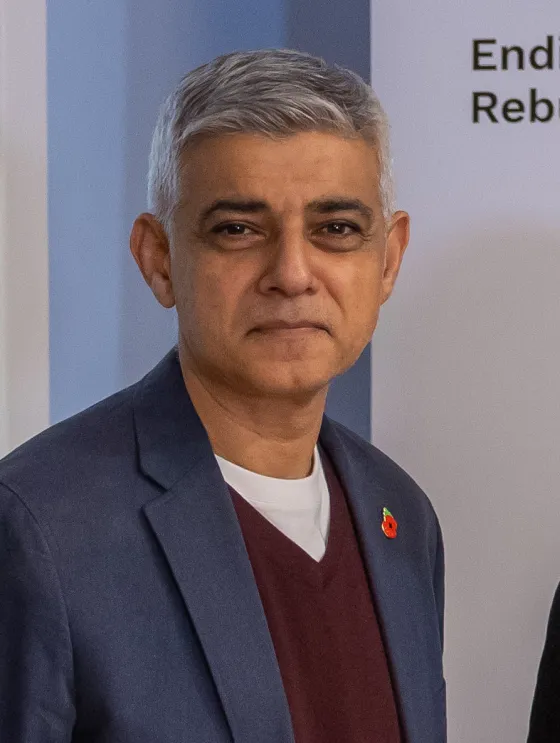
The Achievement
On 5 May 2016, Sadiq Aman Khan won 1,310,143 votes, or 56.8 percent in the final count, defeating Conservative Zac Goldsmith in the London mayoral election. He was inaugurated two days later at Southwark Cathedral, a Church of England building, where he took the oath of office on the Quran. The son of a Pakistani bus driver from Tooting had just become the first Muslim to lead one of the world's great capital cities.
That election happened two weeks after the Brussels bombings and ten days before the Brexit referendum. The political atmosphere in Britain and across Western Europe was not exactly hospitable to demonstrations of pluralism. London voted otherwise.
The milestone requires one honest qualification, and a piece about historical firsts should make it plainly. Ahmed Aboutaleb was appointed Mayor of Rotterdam in January 2009, seven years before Khan. Rotterdam is a major city. Aboutaleb is Muslim. He preceded Khan. The claim that stands is this: Khan was the first Muslim mayor of a major Western capital city, London being a national capital and Rotterdam not. He was also the first Muslim directly elected by voters to lead a major Western city, since Aboutaleb was appointed by the Dutch Council of Ministers rather than chosen at the ballot box. Both distinctions are real and both matter.
From the Henry Prince Estate to City Hall
Sadiq Khan was born on 8 October 1970 at St George's Hospital in Tooting, South London. He grew up in a three-bedroom council flat on the Henry Prince Estate in Earlsfield with his parents and seven siblings. His father, Amanullah, had emigrated from Pakistan with his mother, Sehrun, in 1968. Amanullah spent more than 25 years driving a red London bus. Sehrun worked as a seamstress.
Khan has told the bus driver story many times, and it has not diminished with repetition. He now has strategic oversight of Transport for London. The buses his father drove for a quarter century answer to City Hall. The symmetry is almost too neat, except that it is true.
He grew up in conditions he describes as materially modest but not marked by hardship: a close family, a stable community of other working-class immigrant families in South London, and a household where Sunni Muslim faith was simply part of the fabric of daily life. He and his brothers joined Earlsfield Amateur Boxing Club partly in response to racism they encountered on the streets. He wanted to study dentistry. A teacher redirected him toward law because of his argumentative nature. He has credited the American television drama L.A. Law with confirming the decision.
After Ernest Bevin College, a comprehensive school in Tooting, he read law at the University of North London, graduating in 1991. He qualified as a solicitor in 1994 after completing the Law Society finals at the College of Law in Guildford. He joined Christian Fisher, a specialist human rights firm, becoming a partner in 1997 when the firm later became Fisher Meredith. He also served as chair of Liberty, the National Council for Civil Liberties, one of the UK's leading rights organisations, around 2003 to 2004.
The Road to the Mayoralty
Khan entered formal politics through Wandsworth Borough Council, where he served from 1994 to 2006. He was elected MP for Tooting in 2005, becoming one of the first Muslims elected to the House of Commons. In Gordon Brown's government he was appointed Parliamentary Under-Secretary of State for Communities and Local Government in 2008, then Minister of State for Transport in 2009. He became, by some accounts, the first Muslim to attend Cabinet-level government meetings, though the precise constitutional status of the role is worth noting: Parliamentary Under-Secretaries are not full Cabinet members.
In opposition he served as Shadow Secretary of State for Justice in Ed Miliband's front bench team. He stood down from Parliament in 2016, after eleven years as MP for Tooting, to run for Mayor of London.
The 2016 Campaign: What the Goldsmith Strategy Got Wrong
The 2016 London mayoral election was the first test of whether a Muslim candidate could win a direct citywide election against a well-resourced opponent in a major Western city. The way the Conservative campaign chose to run against Khan made the result mean more than it might otherwise have done.
Zac Goldsmith, son of billionaire Sir James Goldsmith and a sitting MP with substantial name recognition, ran a campaign that Labour described as an effort to link Khan systematically to Islamic extremism. Campaign materials called him "radical and divisive." Leaflets were sent to British Indian, Tamil, and Sikh voters specifically, suggesting Khan could not be trusted and including claims that he might raise taxes on family jewellery, a framing with no policy basis whatsoever.
The condemnation came from inside the Conservative Party as well as outside it. Baroness Sayeeda Warsi, a former Conservative Cabinet minister, denounced the tactics. Andrew Boff, then leader of the Conservative group on the Greater London Assembly, also condemned the approach. Labour MP Yvette Cooper said at one point: "What started as a subtle dog-whistle is becoming a full blown racist scream." The Muslim Council of Britain called it "dog-whistle anti-Muslim racism."
Khan won by 16 percentage points. Final count: Khan 56.8 percent, Goldsmith 43.2 percent.
He was sworn in at Southwark Cathedral, a deliberately chosen Church of England venue. He took the oath on the Quran. His father, the bus driver, was in the audience.
Three Terms: What the Record Means
Khan was re-elected in May 2021 against Conservative Shaun Bailey, winning 55.2 percent in the final count despite the election being delayed a year by COVID-19. He received 1,206,034 final-round votes to Bailey's 977,601.
The 2024 election was the most consequential for his legacy. Running against Conservative Susan Hall under a new first-past-the-post system (the supplementary vote had been replaced by the Elections Act 2022), Khan won 1,088,225 votes, or 43.8 percent, to Hall's 812,397 (33 percent), a margin of 275,828 votes announced on 4 May 2024. He became the first person ever elected to three terms as Mayor of London. No predecessor had managed it. He increased his vote share from 2021 by 3.8 percentage points even as his most contested policy, the ULEZ expansion, had dominated the campaign.
The ULEZ expansion is worth understanding on its own terms. Khan extended the Ultra Low Emission Zone on 29 August 2023 to cover all 32 London boroughs, bringing approximately five million additional Londoners into the zone. Non-compliant vehicles pay £12.50 per day. Five Conservative-led councils went to the High Court to block it. The High Court rejected their challenge. The Uxbridge and South Ruislip by-election in July 2023 returned a Conservative result widely read as a direct voter verdict on the ULEZ in outer London. Khan described the expansion as "probably the hardest thing I've done in my career" and acknowledged receiving death threats over it. By 2024, particle emissions (PM2.5) from vehicle exhausts were estimated at 31 percent lower in outer London than they would have been without the expansion, and NOx from cars and vans 14 percent lower.
In the 2024 New Year Honours, announced on 30 December 2024, Khan was named for a knighthood for political and public service. King Charles invested him at Buckingham Palace. He became Sir Sadiq Khan, the first sitting Mayor of London to receive the honour. A petition against the knighthood gathered 220,000 signatures. The honour proceeded.
The Trump Feud as International Context
The decade-long public conflict between Khan and Donald Trump is, in its own way, a record of how Khan's Muslim identity played out on the world stage after his election.
It began in 2015, when Trump was campaigning for the US presidency on a pledge to ban Muslims from entering the United States. Khan, then still MP for Tooting, called the proposal "outrageous" and "ignorant." Trump responded by challenging him to an IQ test. After Khan became mayor, Trump offered to make him a personal exception to the proposed Muslim travel ban. Khan declined.
The feud escalated sharply after the June 2017 London Bridge terror attack. Trump posted on social media claiming Khan had told Londoners there was "no reason to be alarmed." Khan had said there was no reason to be alarmed by the increased police presence visible across the city. Trump stripped the context and misrepresented the quote. The misrepresentation was widely documented and criticised.
When Trump visited the UK in June 2019, Khan wrote in The Observer that Britain should not "roll out the red carpet" for him. The Trump baby blimp flew over Parliament Square. Khan has consistently described Trump's hostility toward him as motivated by his ethnicity and religion. At the UN General Assembly in September 2025, Khan called Trump "racist, sexist and Islamophobic" in a direct public statement.
What the feud illustrates is not primarily a personality clash. It illustrates what it means for a Muslim to hold executive power in a Western city at the level that can draw that kind of sustained, international attention. Khan did not treat his religion as a liability to be managed. He treated it as part of who he is. That turned out to be a position worth defending publicly, repeatedly, and at some cost.
Faith in Public Life, Without the Title of Faith Leader
Khan is a practising Sunni Muslim. He attends Al-Muzzammil Mosque in Tooting. He fasts during Ramadan and prays when circumstances allow. He has never hidden any of this, and he has never led with it as a political identity.
His stated position draws a careful line: "I have never held myself out as a Muslim leader. But it's a fact I'm a leader of Islamic faith, so that brings with that a responsibility, especially in current times." He has used the mayoralty for explicit interfaith work. In 2016, after his election, he organised iftars to be held simultaneously at synagogues, churches, and mosques across London, with the aim of "breaking down the mystique and suspicion" around Islam. He has installed Ramadan lights in Leicester Square every year.
After the March 2019 Christchurch mosque attacks, he put London mosques on heightened security alert, wrote to the Prime Minister demanding action on Islamophobia, and had the Greater London Authority formally adopt the All-Party Parliamentary Group on British Muslims' definition of Islamophobia, making it the largest public authority in the UK to do so.
The approach he models is not assimilation (minimising faith to seem more acceptable) and not performance (amplifying faith for political effect). It is straightforwardly what it appears to be: a practising Muslim who also runs a city of nine million people, and who thinks both facts are worth being honest about.
Frequently Asked Questions
Who was the first Muslim mayor of a major Western capital city?
Sadiq Khan, elected Mayor of London on 5 May 2016 and inaugurated on 7 May 2016. London is a national capital and one of the world's most significant cities. No Muslim had led a comparable Western capital before Khan. Ahmed Aboutaleb of Rotterdam preceded him as mayor of a major Western city, but Rotterdam is not a national capital, and Aboutaleb was appointed rather than elected.
Was Sadiq Khan really the first Muslim mayor of a major Western city?
Not the first of any major Western city. Ahmed Aboutaleb was appointed Mayor of Rotterdam in January 2009, seven years before Khan's election. Rotterdam has a population of roughly 634,000. The historically precise claim is that Khan was the first Muslim mayor of a major Western capital city, and the first Muslim directly elected by voters to lead a major Western city. Both distinctions are real.
How many times has Sadiq Khan been elected Mayor of London?
Three times. He was first elected in May 2016 against Zac Goldsmith, re-elected in May 2021 against Shaun Bailey, and won a historic third term in May 2024 against Susan Hall. No previous Mayor of London had won three terms. He is the first person to do so.
What was controversial about the 2016 London mayoral campaign?
The Conservative campaign for Zac Goldsmith sent materials to British Indian, Tamil, and Sikh voters suggesting Khan could not be trusted, including claims about a tax on family jewellery with no policy basis. Campaign materials called Khan "radical and divisive." The approach was condemned as Islamophobic not only by Labour but by senior Conservatives including Baroness Sayeeda Warsi and GLA Conservative group leader Andrew Boff. Khan won by 16 percentage points.
When was Sadiq Khan knighted?
Khan was named in the 2024 New Year Honours List, announced on 30 December 2024, and invested by King Charles at Buckingham Palace. He is now Sir Sadiq Khan, the first sitting Mayor of London to receive a knighthood.