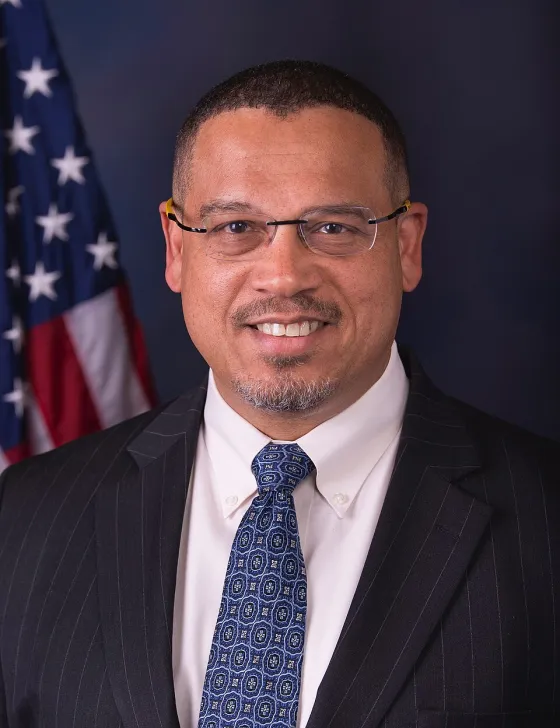
The Achievement
On November 7, 2006, Keith Ellison won Minnesota's 5th Congressional District with 55.6 percent of the vote, defeating Republican Alan Fine and Independence Party candidate Tammy Lee. He was sworn in on January 4, 2007, becoming the first Muslim to serve in the United States Congress and, simultaneously, the first African American elected to Congress from Minnesota.
Two hundred and thirty years of congressional history. Thousands of members. None had been Muslim. The U.S. Constitution's Article VI, Clause 3 explicitly prohibits religious tests for office, but social and political barriers had functioned as an unofficial substitute for most of that history. Ellison's election made the constitutional guarantee concrete.
The moment also generated one of the more widely misreported stories in modern American political journalism: a controversy over a Quran, a photograph, and a fundamental misunderstanding of how the congressional oath actually works.
From Detroit to Minneapolis: The Road to Congress
Keith Maurice Ellison was born on August 4, 1963, in Detroit, Michigan, the third of five sons. His father, Leonard Ellison, was a psychiatrist. His mother, Clida Ellison, was a social worker. He was raised Catholic, attended the University of Detroit Jesuit High School, and enrolled at Wayne State University to study economics.
His conversion to Islam happened during his sophomore year at Wayne State, around 1982, when he was approximately 19 years old. The circumstances were unremarkable in the best way: he was studying calculus with a Libyan classmate who told him he had to leave for Jumu'ah, the Friday congregational prayer. Ellison asked what that was. His friend invited him along.
What he found was people removing their shoes and sitting in a hallway while a speaker addressed themes of racial justice and social equality. Ellison was already involved in anti-apartheid activism at the time. He later described his reaction: "It was Islam's message of social justice and equality that affected me the most and satisfied my spiritual yearning." Over the following weeks he read the Quran, then spent a month at a Muslim center in Detroit before taking the Shahada, the Islamic declaration of faith.
He graduated from Wayne State with a B.A. in economics in 1987, then earned his J.D. from the University of Minnesota Law School in 1990. He settled in Minneapolis, working as a civil rights attorney before entering state politics. He was elected to the Minnesota House of Representatives in 2002, representing District 58B, and served from 2003 to 2007.
The 2006 Race: Won in the Primary
Minnesota's 5th congressional district, centered on Minneapolis, had not sent a Republican to Congress since 1963. When incumbent Martin Olav Sabo announced his retirement in March 2006 after 28 years, the real contest was always going to be the Democratic-Farmer-Labor primary, not the general election.
The primary drew a crowded field. Sabo's own chief of staff, Mike Erlandson, entered with the incumbent's endorsement. Former state senator Ember Reichgott Junge and Minneapolis city council member Paul Ostrow also ran. Hennepin County commissioner Gail Dorfman was considered a frontrunner based on early fundraising.
At the district DFL convention in May, Ellison secured the party endorsement after four ballots, a result that surprised analysts who had expected a three-way race. In the September 12 primary, he won 41 percent of the vote outright. The November general election was a formality in a district rated D+32 by the Cook Partisan Voting Index. Ellison won with 55.6 percent. Fine (Republican) and Lee (Independence Party) each finished around 21 percent, effectively tied for second.
Jefferson's Quran: What Actually Happened
Here is the part most coverage gets wrong, and it matters.
The official swearing-in of House members happens on the House floor on the first day of the new Congress. All 435 members take the oath simultaneously in a group ceremony administered by the Speaker of the House. No book of any kind is used. No Bible, no Constitution, no Quran. The official oath is administered verbally, in mass, and is the only ceremony with any legal standing. On January 4, 2007, Nancy Pelosi administered that oath to all members of the 110th Congress at once. That is when Ellison became a congressman.
After the floor ceremony, members proceed individually to the Speaker's Ceremonial Office for personal photo sessions, often accompanied by family. This is a tradition. Members frequently bring a book that is personally meaningful for the photograph. It carries zero legal weight. It is a photo opportunity.
What Ellison did with Jefferson's Quran was for the photo session, not the official oath. The countless headlines saying he "was sworn in on the Quran" were technically wrong. He posed for a ceremonial photo holding it after the actual oath had already been administered without any book.
The Quran itself has a remarkable history. Thomas Jefferson purchased the two-volume work in Williamsburg, Virginia in 1765, while studying law at the College of William and Mary. It is the second edition of George Sale's 1734 English translation, considered among the finest early translations made directly from the Arabic. Jefferson's purchase was consistent with his practice of studying all major legal traditions. When the British burned Washington in 1814 during the War of 1812, they destroyed the Congressional Library. Jefferson sold his entire personal library, approximately 6,500 titles, to Congress in 1815 to help rebuild it. The Quran came with that collection. It has been in the Library of Congress ever since, rebound by the library in 1918, residing in the Rare Book and Special Collections Division.
Ellison contacted the Library in early December 2006, explaining he wanted a Quran with special significance. Mark Dimunation, head of the Rare Book Division, arranged the loan. The choice was strategically and symbolically exact: the book Ellison held was not foreign to American history. It was purchased by a Founding Father for legal study, survived the burning of Washington, and had been public American property for over 200 years.
The Virgil Goode Letter
On December 7, 2006, Virginia Congressman Virgil Goode (Virginia's 5th congressional district) wrote a letter to a constituent in Earlysville, Virginia, warning that Ellison's election represented a threat. The letter circulated widely in mid-December.
What made the letter notable was not the objection to the Quran. It was where Goode's actual argument led. He explicitly tied his concern to immigration policy, writing that unless Americans adopted stricter limits on legal immigration and ended the diversity visa program, "there will likely be many more Muslims elected to office and demanding the use of the Koran."
Several claims in the letter were factually wrong. Goode's framing implied Ellison was an immigrant or had benefited from immigration. Ellison was born in Detroit, Michigan. His family had lived in the United States for generations. He had no connection to immigration policy. Goode's real concern, stated plainly in the letter, was about Muslim demographic presence in America, not about any procedural question regarding oath administration.
The constitutional response was straightforward. Article VI, Clause 3 states that "no religious Test shall ever be required as a Qualification to any Office or public Trust under the United States." This clause, ratified in 1788, was designed precisely to prevent the argument Goode was making. The same Constitution he claimed to be defending explicitly forbids what he was calling for. Theodore Roosevelt took the presidential oath in 1901 with no book at all. Kyrsten Sinema used a copy of the Constitution in 2019. Tulsi Gabbard used the Bhagavad Gita in 2013. Each choice is equally valid under Article VI.
Goode declined to apologize. Ellison responded publicly by saying Goode "needs to understand that there is nothing to fear." When Congress convened in January, Ellison approached Goode personally on the House floor to introduce himself and offer to meet for coffee.
Six Terms in Congress
Ellison served from January 4, 2007, to January 3, 2019, representing Minnesota's 5th district across six terms. He served on the House Financial Services Committee for all 12 years, along with assignments on the House Foreign Affairs Committee and the House Judiciary Committee.
He co-chaired the Congressional Progressive Caucus and helped build its membership to over 100 members. He also served as Chief Deputy Whip of the House Democratic Caucus, founded the Congressional Antitrust Caucus, and founded the Congressional Consumer Justice Caucus.
In February 2017, Ellison ran for chair of the Democratic National Committee as the progressive candidate, backed by Bernie Sanders, Elizabeth Warren, Chuck Schumer, and John Lewis. He lost narrowly to Tom Perez on the second ballot, 200 to 235. Perez subsequently appointed him DNC Deputy Chair, making him the highest-ranking Muslim American in a major political party at that time.
His legislative accomplishments included the Methamphetamine Production Prevention Act of 2007, the Money Remittances Improvement Act of 2014, provisions protecting credit card holders from abusive practices, and provisions protecting renters' rights.
What Came After Congress
In 2018, Ellison chose not to seek a seventh congressional term and instead ran for Minnesota Attorney General. He won by more than 100,000 votes on November 6, 2018, becoming the 30th Attorney General of Minnesota, the first Black person elected to statewide office in Minnesota, and the first Muslim elected to a statewide office anywhere in the United States.
His most consequential work as AG came in 2020 and 2021. After the murder of George Floyd by Minneapolis police officer Derek Chauvin on May 25, 2020, Ellison took over prosecution of the case. His team of 14 attorneys worked for 11 months building the case. On April 20, 2021, Derek Chauvin was convicted of second-degree unintentional murder and second-degree manslaughter. The verdict was the first conviction of a Minneapolis police officer for an on-duty killing.
The Path After Ellison
André Carson of Indiana became the second Muslim elected to Congress on March 11, 2008, winning a special election to fill the seat vacated by the death of his grandmother, Rep. Julia Carson. He defeated Republican Jon Elrod with 53 percent of the vote, then won the full-term November election with 65 percent. Carson has served continuously since then and is currently the longest-serving Muslim member of Congress. He went on to serve on the House Intelligence Committee, a sensitive assignment that carried its own significance given earlier rhetoric about Muslim members' fitness for such roles.
In 2018, Ilhan Omar won Minnesota's 5th district, the seat Ellison vacated, and Rashida Tlaib won Michigan's 13th district. Both used Qurans for their ceremonial photos. Both became the first Muslim women elected to Congress.
Ellison's significance extends beyond the count of who followed. He demonstrated that a Muslim candidate could win a district that was not majority-Muslim, that religious identity did not need to be minimized to succeed, and that the constitutional guarantee of no religious test was not merely symbolic. Every Muslim member of Congress who came after entered a space that did not exist before November 7, 2006.
Frequently Asked Questions
Who was the first Muslim elected to Congress?
Keith Ellison was the first Muslim elected to the United States Congress. He won Minnesota's 5th Congressional District seat on November 7, 2006, and was sworn in on January 4, 2007. He was also the first African American elected to Congress from Minnesota.
Did Keith Ellison take his oath on the Quran?
Not during the official ceremony. The official congressional oath is administered verbally to all 435 members at once on the House floor, with no book involved. After that ceremony, Ellison used Thomas Jefferson's personal Quran for a separate ceremonial photo session with Speaker Nancy Pelosi. That photo session has no legal standing. Many news reports conflated the two events.
Whose Quran did Keith Ellison use?
Thomas Jefferson's. Jefferson purchased the two-volume Quran in Williamsburg, Virginia, in 1765, while studying law. It is the second edition of George Sale's 1734 English translation. Jefferson sold his entire personal library, roughly 6,500 books, to Congress in 1815 to help rebuild the collection destroyed when the British burned Washington. The Quran has been Library of Congress property ever since. Ellison borrowed it from the Rare Book and Special Collections Division.
When did Keith Ellison convert to Islam?
Around 1982, when he was approximately 19 years old and a sophomore at Wayne State University in Detroit. He was raised Catholic. A Libyan classmate he was studying calculus with invited him to Friday prayer. Within a month he had taken the Shahada, the Islamic declaration of faith.
Who was the second Muslim elected to Congress?
André Carson of Indiana. He won a special election on March 11, 2008, to represent Indiana's 7th Congressional District, following the death of his grandmother, Rep. Julia Carson. He has served continuously since then and is the longest-serving Muslim member of Congress.
Is Keith Ellison still in Congress?
No. Ellison served six terms (2007-2019), then ran for Minnesota Attorney General. He won on November 6, 2018, becoming the 30th Attorney General of Minnesota. He is the first Muslim elected to a statewide office in the United States and the first Black person elected to statewide office in Minnesota.