A History Older Than the Nation
Muslim service in the American military predates the country itself. Historians estimate that between 15 and 30 percent of the enslaved Africans brought to colonial America came from Muslim-majority regions: Senegambia, Guinea, Sierra Leone, Mali. When the Revolutionary War broke out, approximately 5,000 Black soldiers (free and enslaved) took up arms for the Continental cause. A portion of them were Muslim.
Their names appear on muster rolls. Bampett Muhamed served in the Virginia Line as a corporal between 1775 and 1783. Yusuf ben Ali, of North African Arab descent, served as an aide to General Thomas Sumter in South Carolina. Joseph Saba appears on additional Revolutionary War records. The National Museum of African American History and Culture confirms that "African Muslims fought alongside colonists during the Revolutionary War (1775-1783)."
Scholars are careful to note that a Muslim-sounding name suggests but does not conclusively prove religious practice. Some of these men may have been culturally Muslim by origin but not practicing. That caveat matters. What is not in doubt is that people from Muslim-majority regions and Muslim families were part of the founding military effort, a fact the 116th Congress formally recognized in H. Res. 276.
For most of American history, the military did not record religious affiliation systematically. Muslim soldiers served in the War of 1812, the Mexican-American War, and the Civil War without their faith appearing in official records. The full picture of early Muslim military service is still being reconstructed, archive by archive.
Civil War: Nicholas Said and the 55th Massachusetts
The most thoroughly documented Muslim-origin serviceman from the 19th century is Mohammed Ali ben Said, who later took the name Nicholas Said.
Said was born in 1836 in Kouka, in the Bornu Empire (present-day northeastern Nigeria and Chad). His father, Barca Gana, was a distinguished military general of that empire. Around age 15, Said was captured during a Tuareg Berber raid and transported across the Sahara into a succession of Arab, Turkish, and Russian households. His captivity took an unusual turn: his linguistic ability drew notice, and he was educated rather than simply exploited. By adulthood he spoke Arabic, Ottoman Turkish, Russian, German, Italian, and French.
He made his way eventually to North America, settling in Detroit and teaching school. When the Civil War began, he enlisted in the 55th Massachusetts Infantry Regiment, one of the United States Colored Troops units. He served as a clerk in the adjutant's office and regimental hospital, where his literacy was an asset. His memoir, "The Autobiography of Nicholas Said," published in 1873, is the longest extant slave narrative by an enslaved African Muslim.
One important clarification: Said converted to Christianity in Riga, Latvia, on November 12, 1855, before ever setting foot in North America. He explicitly recorded leaving his "Mohammedan name of Mohammed Ali Ben Said at the font." He served the Union as a Christian convert. His Muslim origins and the Muslim world that shaped his early life are central to his story, but he was not a practicing Muslim during his military service. He is best understood as a Muslim-born Civil War soldier, and the most significant figure connecting early Islamic African heritage to American military history.
From Blank Dog Tags to 63 Faith Emblems
For roughly 200 years of American military history, Muslim service members had no chaplain, and in some cases no official acknowledgment of their faith at all. The latter problem took a concrete form during World War II.
Abdullah Igram of Cedar Rapids, Iowa, grew up near the oldest mosque in the United States, the son of Lebanese immigrants. When he reported for military service and received his dog tag, the clerk told him his options were P (Protestant), C (Catholic), or J (Jewish). Igram requested "M" for Muslim. The answer was no. His tag was left blank.
After the war, Igram did not drop the matter. He wrote to the Secretary of the Army and eventually to President Eisenhower in 1953, requesting formal military recognition of Islam on official identification. By the Vietnam era, the one-letter abbreviation system had been replaced with full religious affiliations, and "Muslim" was among the recognized options. Igram's sustained campaign is credited as a key catalyst for that change.
The arc continues to the present. The Department of Veterans Affairs currently authorizes 63 faith emblems for military headstones and markers, including the crescent and star. From a blank dog tag in the 1940s to a formally recognized symbol at Arlington, the shift required three decades of individual persistence and institutional pressure.
First Muslim Chaplain: Abdul-Rasheed Muhammad
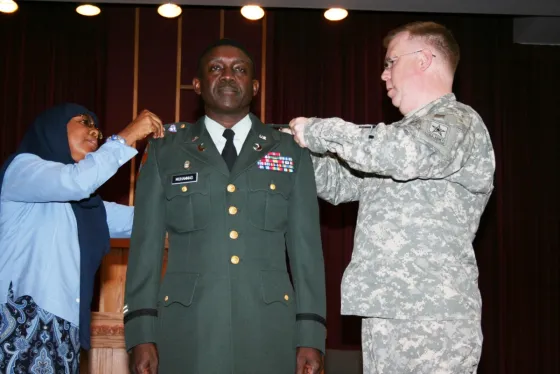
On December 3, 1993, Abdul-Rasheed Muhammad was sworn in as a chaplain candidate at the Pentagon. Army chaplain Colonel Herman Keizer Jr. marked the moment plainly: "This is the first non-Judeo-Christian faith group to have representation." Muhammad completed his candidacy in April 1994 and became the first active-duty Muslim chaplain in U.S. history, subsequently posted to Fort Bragg, North Carolina.
Muhammad's path to that ceremony was not direct. Born and raised in Buffalo, New York, in a Methodist and Baptist household, he was drawn to Islam in his twenties, inspired by the examples of Malcolm X and Muhammad Ali. He became Muslim in 1973 as an undergraduate. He earned a master's degree in social work from the University of Michigan, became an imam in 1978, and spent years as a chaplain in the New York Department of Corrections before pursuing military chaplaincy.
The institutional barriers were real. The military chaplaincy had operated within a Protestant-Catholic-Jewish framework for its entire existence. Adding an Islamic chaplain required a recognized endorsing body, updated training protocols, and the willingness of military leadership to treat Islam as a faith deserving the same institutional support as those it had served for centuries. Muhammad navigated all of it. He served more than 20 years.
Before his commissioning, Muslim service members had no one to lead Friday prayers, no Islamic rite for the dying, and no religious advocate inside the institution. That absence had lasted as long as the country had an army.
Humayun Khan and the Post-9/11 Reckoning
Captain Humayun Saqib Muazzam Khan was born on September 9, 1976, in the United Arab Emirates, to Pakistani immigrant parents Khizr and Ghazala Khan. He grew up in the United States, attended the University of Virginia, and pursued an officer's commission through ROTC.
On June 8, 2004, 120 days into his Iraq deployment, Khan was inspecting a guard post near Baqubah when a suspicious taxicab accelerated toward the gate. He ordered his soldiers back. Then he moved toward the vehicle. The bomb detonated before it reached the installation entrance or the mess hall where hundreds of soldiers were eating. Khan died in the blast. He was 27. He was posthumously awarded the Bronze Star and the Purple Heart. He is buried at Arlington National Cemetery, his headstone bearing the crescent and star.
His name entered the national consciousness twelve years later. On July 28, 2016, the final night of the Democratic National Convention in Philadelphia, Khizr Khan took the stage holding a pocket-sized copy of the U.S. Constitution. He directed his remarks at the Republican nominee: "Donald Trump, you're asking Americans to trust you with their future. Let me ask you, have you even read the United States Constitution? I will gladly lend you my copy." Ghazala Khan stood beside him, silent, overcome by grief. When Trump questioned her silence by implying Islamic custom had silenced her, Ghazala responded with a Washington Post op-ed: she had been unable to speak because she could not look at her son's image without breaking down.
Humayun Khan was not the only Muslim soldier to die in post-9/11 wars. Fourteen Muslim-American service members were killed in Iraq in the decade following September 11, according to Department of Homeland Security figures. But his story became the most publicly visible.
A related moment came three years after Humayun's death. Photographer Platon captured Elsheba Khan, mother of Specialist Kareem Rashad Sultan Khan, kneeling at her son's grave at Arlington. The headstone bore the crescent and star. Kareem Rashad Sultan Khan had enlisted after 9/11 specifically to counter stereotypes about Muslims. He was killed on August 6, 2007, in Baqubah, while clearing a house. Colin Powell saw the photograph. On October 19, 2008, during a Meet the Press appearance in which he endorsed Barack Obama, Powell addressed the question directly: "Is there something wrong with being a Muslim in this country? The answer's no, that's not America. Is there something wrong with some seven-year-old Muslim-American kid believing that he or she could be president?" He described the headstone with its crescent and star: "He was an American. He was a soldier."
Two Milestones for the Chaplaincy
Twenty-six years after Abdul-Rasheed Muhammad became the first Muslim military chaplain, the chaplaincy reached another milestone. On December 18, 2019, Saleha Jabeen was commissioned as a chaplain in the United States Air Force, becoming the first female Muslim chaplain in the entire Department of Defense. She was assigned to the 517th Training Group at the Presidio of Monterey, California. Her ecclesiastical endorsement came from the Islamic Society of North America. She had trained at Catholic Theological Union in Chicago, reflecting the interfaith structure of military chaplaincy education.
Air Force Chief of Chaplains Maj. Gen. Steven Schaick framed her commissioning in institutional terms: "Any time we advance religious freedoms, it's a win for all persons of faith. The Chaplain Corps exists to ensure every Airman has a religious freedom advocate."
The distinction between Muhammad's and Jabeen's milestones is worth stating plainly. Muhammad's was the first of any Muslim chaplain in U.S. military history. Jabeen's was the first female Muslim chaplain across all branches. Both represent the same pattern: an institution that took centuries to formally recognize Islam, then made incremental changes in response to individuals who pressed for inclusion.
The First Muslim General Officers
On July 3, 2024, Cindy M. Saladin-Muhammad was promoted to Brigadier General in the U.S. Army Reserve, becoming the first Muslim promoted to general officer rank in the history of the United States military. She is also the first Muslim woman to reach that rank and the fifth African-American woman in U.S. history promoted to the rank of general.
Her career began in January 1984, when she entered the Army as a private. She was commissioned as a second lieutenant in 1993 through Officer Candidate School, the same year Muhammad became the first Muslim chaplain. Her career moved through platoon leadership and maintenance officer roles before she transitioned to the Medical Service Corps as an Environmental Science and Engineering Officer. In 2003, she deployed in support of Operation Enduring Freedom and Operation Iraqi Freedom, serving as Preventive Medicine Officer-in-Charge at Fort Dix, New Jersey. She holds a Doctorate in Business Administration and degrees from Rutgers University, Temple University, the University of Medicine and Dentistry of New Jersey, and the U.S. Army War College. After her promotion, she was assigned as Deputy Commanding General of the 99th Readiness Division at Fort Knox, Kentucky.
A second Muslim general followed the next year. On August 20, 2025, Shariful M. Khan was sworn in as a Brigadier General in the United States Air Force at the Pentagon, with the oath administered by Gen. Sean Bratton, Vice Chief of Space Operations. Khan became the first Bangladeshi-American to reach general officer rank in the U.S. military. He was commissioned from the U.S. Air Force Academy in 1997, commanded the 379th Space Range Squadron and the 310th Space Wing at Schriever Space Force Base, and was assigned after his promotion to direct the staff of the "Golden Dome for America" missile defense program.
From JAG Officer to the Federal Bench
Zahid Quraishi's path from military service to the federal bench traces a route through two of the most significant Muslim firsts in American institutional history.
Quraishi grew up in Fanwood, New Jersey, the son of Pakistani immigrants. He earned his law degree from Rutgers in 2000 and joined the U.S. Army Judge Advocate General's Corps in June 2003. He served two tours in Iraq: the first in early 2004 in Tikrit, advising on detainee operations and rules of engagement in an active combat zone; the second in August 2006 in Ramadi, during some of the most intense fighting of the war. He left the Army in 2007 at the rank of Captain.
His post-military career moved through immigration enforcement, federal prosecution, and the federal magistrate bench. On June 10, 2021, the Senate confirmed him 81-16 as a U.S. District Judge for the District of New Jersey, making him the first Muslim American Article III federal judge in U.S. history.
There is a geographic footnote worth noting. Quraishi is from Fanwood, New Jersey. Cindy Saladin-Muhammad is from Newark. Kareem Rashad Sultan Khan was born in Neptune, New Jersey. Multiple Muslim American firsts trace back to the same state, a concentration that says something about community, opportunity, and the particular paths that open when both are present.
The Incomplete Record
The history documented here is not the whole history. It is the recoverable portion of it.
For most of American military history, religious affiliation was not systematically recorded. Muslim soldiers who served in the Revolution, the Civil War, the World Wars, Korea, and Vietnam did so largely without their faith being noted. The military's recognition of Islam evolved in stages: blank dog tags in the 1940s, Abdullah Igram's letters to the Army and the White House through the early 1950s, full religious options by the Vietnam era, the first chaplain in 1994, and 63 authorized headstone emblems today. Each step was the result of someone pressing for recognition that had been withheld.
The pattern across all these stories is consistent. Muslim Americans served in full, were recognized partially, and pressed for the rest. Bampett Muhamed on a muster roll in 1775. Abdullah Igram with a blank dog tag. Abdul-Rasheed Muhammad at the Pentagon in 1993. Cindy Saladin-Muhammad pinning on a general's star in 2024. The thread is 250 years long and still being traced.
Frequently Asked Questions
Who was the first Muslim in the U.S. military?
The earliest documented Muslim military service dates to the Revolutionary War. Men with identifiably Muslim names appear on Continental Army muster rolls, including Bampett Muhamed, who served in the Virginia Line as a corporal from 1775 to 1783. Scholars estimate 15 to 30 percent of enslaved Africans in colonial America came from Muslim-majority regions, and approximately 5,000 Black soldiers served the Revolutionary cause.
Who was the first Muslim military chaplain?
Abdul-Rasheed Muhammad. He was sworn in as a chaplain candidate at the Pentagon on December 3, 1993, and completed his candidacy in April 1994, becoming the first active-duty Muslim chaplain in U.S. history. He was subsequently posted to Fort Bragg, North Carolina, and served more than 20 years.
Who was the first female Muslim military chaplain?
Saleha Jabeen, commissioned in the U.S. Air Force on December 18, 2019. She represents the first female Muslim chaplain in the entire Department of Defense, not just the Air Force. She was assigned to the 517th Training Group at the Presidio of Monterey, California.
Who was the first Muslim general officer in the U.S. military?
Cindy M. Saladin-Muhammad, promoted to Brigadier General in the U.S. Army Reserve on July 3, 2024. She is also the first Muslim woman to achieve general officer rank and the fifth African-American woman in U.S. history promoted to that rank. Shariful M. Khan followed as the second Muslim general officer, commissioned as a Brigadier General in the U.S. Air Force on August 20, 2025.
How many Muslims serve in the U.S. military?
The Department of Defense counted approximately 5,897 active Muslim military members as of December 2015, representing about 0.45 percent of total personnel. The actual number is likely higher, as roughly 400,000 service members had not self-reported a religious affiliation at that time. Religious disclosure in the military is voluntary.