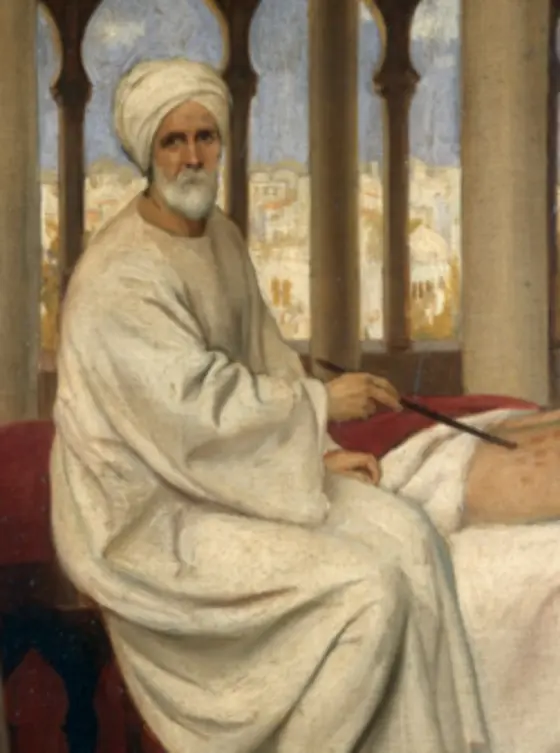
The Achievement
Abu al-Qasim al-Zahrawi was born around 936 CE in a palace city just outside Cordoba, in the most intellectually advanced region of 10th-century Europe. He died around 1013 CE, having spent his entire career practicing and documenting surgery in that same city. The textbook he left behind, a 30-volume medical encyclopedia called Kitab al-Tasrif, became the primary surgical reference in European universities for roughly 500 years after it was translated into Latin in the 12th century.
For five centuries, if you trained as a surgeon in Europe, you learned from a Muslim physician in Cordoba. Every major European surgical author from the 12th through the 16th centuries cited or copied from him. The School of Salerno adopted his work. The University of Montpellier adopted it. His surgical instruments, drawn in detail in his text, were reproduced across the continent by practitioners who had never been within a thousand miles of Al-Andalus.
Al-Zahrawi is not a marginal historical figure who has been recently elevated for political reasons. He is called the father of modern surgery in peer-reviewed journals from the Annals of Vascular Surgery to Frontiers in Medicine. Columbia University's surgery department has published formal recognition of his role. The title is contested, and honestly so, but the contest is between two serious historical claims, not between a well-documented figure and an invented one.
Cordoba in the Tenth Century
Al-Zahrawi did not emerge from a vacuum. He was born the same year Caliph Abd al-Rahman III founded Madinat al-Zahra, the palace city where al-Zahrawi spent his early life. The timing matters: the Caliphate of Cordoba was at the height of its intellectual output when al-Zahrawi was being educated.
Cordoba around 1000 CE was one of the two largest cities in Europe alongside Constantinople. Population estimates vary widely in the historical literature, from roughly 350,000 to over one million, but even the conservative figures place Cordoba far ahead of any Western European city of that era. The city held more than 80 libraries and institutions of learning. Under Caliph Al-Hakam II, who became al-Zahrawi's patron, the royal library employed over 500 people and reportedly held more than 400,000 volumes. Historians estimate that 70,000 to 80,000 manuscripts were copied annually in Cordoba alone during the 10th century.
This is the context in which al-Zahrawi worked. The Caliphate of Cordoba had preserved and extended centuries of Greek, Persian, and Indian medical knowledge, translated into Arabic and actively debated. Al-Zahrawi built on Galen, Dioscorides, and Byzantine medical tradition, but he went substantially beyond them, particularly in surgery, which classical Greek tradition had largely disparaged as beneath the physician's dignity. Al-Zahrawi spent roughly 50 years turning his clinical observations into a systematic text that would outlast the civilization that produced it.
Kitab al-Tasrif: The Book That Taught Europe to Operate
The full Arabic title translates roughly as "The Arrangement of Medical Knowledge for One Who Is Not Able to Compile a Book for Himself." Al-Zahrawi completed it around 1000 CE. The 30 volumes cover surgery, medicine, orthopaedics, ophthalmology, pharmacology, nutrition, dentistry, childbirth, and pathology.
The 30th volume, "On Surgery and Instruments," is the one that made surgical history. Three structural sections organized it: wound care; minor surgical operations, ophthalmology, and oral disease; and fractures, dislocations, and gynecology. What made this volume unprecedented was not only what it described but how. Al-Zahrawi drew detailed diagrams of each instrument alongside the procedure it served.
In an era before standardized medical education or printing, that combination was transformative. A surgeon in Salerno could replicate an instrument from Cordoba based solely on al-Zahrawi's drawings. The book was the first illustrated independent work on surgery in history, functioning not just as a record but as a reproducible manual.
Gerard of Cremona translated the surgery volume into Latin around 1150-1187 CE as part of the Toledo Translation project, the massive 12th-century effort to render Arabic scholarship into Latin for European audiences. The Latin version circulated as "Liber Alsaharavi de Cirurgia." It became standard at the School of Salerno, the oldest medical school in Europe, and at the University of Montpellier, founded 1220 CE. Every major European surgical author from the 12th to the 16th centuries cited or drew from it: Roger of Salerno, Guglielmo Salicetti, Lanfranchi, Henri de Mondeville, Mondinus of Bologna, Bruno of Calabria, and Guy de Chauliac, among others. Surgeons continued relying on the text into the 1700s.
The Instruments: 200 Drawings That Changed Surgery
Al-Zahrawi is credited with documenting or designing over 200 surgical instruments in the surgical volume of Kitab al-Tasrif. Some he invented; others he adapted from earlier traditions. All of them he illustrated with working drawings, making them reproducible.
The instruments spanned nearly every surgical domain of the era. Cutting instruments included multiple scalpel configurations. Retractors and double-tipped surgical hooks allowed surgeons to access anatomy more precisely. Multiple forceps configurations handled different grasping needs. Specula for vaginal and rectal examination, a tongue depressor, bone saws, catheters, tooth extractors, and obstetric devices all appear, each with descriptive text and a drawing. Cauterization instruments appear throughout, since al-Zahrawi used cauterization extensively and documented its appropriate and inappropriate applications.
The practical effect of this documentation was standardization at a time when surgical instruments had no standard forms. The drawings in al-Tasrif gave European surgeons a shared reference point that persisted for centuries.
Catgut: What a Monkey Eating an Oud String Taught Surgery
Among al-Zahrawi's most enduring contributions is the use of catgut for internal sutures, and the origin story is specific enough to deserve its own telling.
Al-Zahrawi noticed his pet monkey had eaten the strings of his oud, a stringed instrument common in Andalusian households. The monkey suffered no intestinal damage from swallowing the gut-derived strings. Al-Zahrawi reasoned that if the body could pass those strings without harm, similar material might be safely used inside the human body for internal stitching without requiring removal. He tested the hypothesis, confirmed it, and documented the technique in Kitab al-Tasrif.
Catgut is made not from cat intestines, as the name misleadingly suggests, but from the intestines of sheep or horses. Unlike silk or linen sutures, which must either be surgically removed or remain in the body permanently, catgut is a natural material the body can absorb. The principle al-Zahrawi established, that internal sutures should dissolve rather than require a second procedure, became fundamental to surgery. Absorbable catgut sutures remained in clinical use until the 20th century, when synthetic alternatives like polyglycolic acid and polyglactin eventually replaced them. The underlying logic he worked out from his oud-playing monkey is still the standard.
Vessel Ligation: The Technique That Was Credited to Someone Else
Kitab al-Tasrif describes the ligation of blood vessels, tying them off to control hemorrhage, as an alternative to cauterization. This is one of the most fundamental techniques in surgery. You cannot perform a major operation without it.
Many Western medical histories credit Ambroise Pare (1510-1590), the French military surgeon, with introducing vessel ligation for controlling bleeding during amputations, specifically as a replacement for the boiling oil treatment applied to gunshot wounds. The problem with that framing: al-Zahrawi described vessel ligation in Kitab al-Tasrif approximately 500 to 600 years before Pare. The same text contains the first surgical description of temporal artery ligation for migraine treatment, another technique attributed to far later practitioners in many Western accounts.
Pare did make important contributions. He improved prosthetics, wrote on obstetrics and wound care, and his influence on 16th-century European surgery was substantial. But the technique of vessel ligation was not his invention. It was in al-Zahrawi's text, available in Latin translation since the 12th century, used in the medical schools Pare's predecessors attended.
Hemophilia and the Firsts That Changed Medicine
In the second essay of Kitab al-Tasrif, al-Zahrawi described a condition he called "blood disease": men who bled excessively from minor wounds. He noted the hereditary pattern, that the condition passed through families, affecting men while women transmitted it without being visibly affected themselves. This is the earliest known clinical description of hemophilia in the medical literature, and the first recorded recognition of its hereditary transmission pattern.
That observation predates the modern understanding of hemophilia as an X-linked recessive disorder by roughly 900 years. But the clinical accuracy was there: male expression, female transmission, hereditary in nature.
Al-Zahrawi's documented surgical firsts extend across several specialties:
He is credited in peer-reviewed literature with performing the first thyroidectomy. He gave the first known description of an abdominal (ectopic) pregnancy. He made early contributions to neurosurgery through descriptions of head injury management. On the airway, his role is genuinely uncertain: one account credits him with performing tracheotomy as an emergency; another describes him treating a self-inflicted throat wound and demonstrating that a laryngeal incision could heal. The evidence is conflicting enough that the honest framing is "described or performed" rather than claiming a clean first.
In dentistry, his contributions are among the most thoroughly documented. He used gold and silver wire to stabilize loose teeth, the first recorded use of wire in dental treatment. He described tooth replantation, the reimplanting of an extracted tooth. He developed instruments for cataract surgery and for kidney stone removal. His book contains the earliest illustrations of dental instruments.
The "Father of Surgery" Title: A Genuine Debate
The title "Father of Modern Surgery" is not uncontested, and engaging honestly with that fact is more interesting than pretending otherwise.
The competing claim belongs primarily to Ambroise Pare. Pare was a French barber-surgeon who rose through military campaigns, served as surgeon to four French kings, wrote major works on surgery and anatomy, and transformed how 16th-century European surgeons treated wounds. His famous remark, "I dressed him, God cured him," captured a philosophy of surgical humility that influenced generations of practitioners. In many Western medical histories, Pare is the one called the Father of Modern Surgery.
The distinction usually drawn between the two claims: al-Zahrawi is the founder of surgery as a systematic, documented discipline. Pare is the figure who moved European surgery into what historians frame as its modern period. One framing gives al-Zahrawi the title "Father of Operative Surgery," reserving "Father of Modern Surgery" for Pare. Contemporary medical historians, including those publishing in peer-reviewed journals like the Annals of Saudi Medicine, Annals of Vascular Surgery, and Frontiers in Medicine, generally give al-Zahrawi the stronger claim precisely because Pare himself was building on a tradition that ran directly through al-Zahrawi's text.
There is also a third claimant: Sushruta, the ancient Indian surgeon, roughly 600 BCE, whose Sushruta Samhita describes hundreds of surgical procedures including rhinoplasty and cataract surgery. Sushruta holds the "Father of Surgery" title in the Indian medical tradition. The "father of" framing, applied to medicine as to most fields, tends to flatten a genuinely multi-civilizational history into a single founding figure. The honest answer is that al-Zahrawi, Pare, and Sushruta each deserve recognition on their own terms and in their own contexts.
What separates al-Zahrawi's claim from most competing ones is the direct, documented chain of transmission. His text, translated into Latin, used in European schools for 500 years, cited by every major European surgical author for four centuries, shaped the tradition Pare was working within. You can trace it. The influence is not asserted; it is recorded.
What Was Erased and What Remained
There is a particular irony in al-Zahrawi's historical position. His house on Calle Albucasis in Cordoba still stands, with a bronze plaque from the Spanish Tourist Board. Forty or more manuscript copies of his work survive in libraries from Oxford to Patna. Every major European surgeon for four centuries put his name in their citations. And he is almost entirely unknown to the general Western reader.
Part of the explanation is the nature of how textbooks transmit knowledge. When a foundational text is used long enough, it stops being attributed to its author and starts being treated as general knowledge. The techniques in al-Tasrif became standard practice, and standard practice rarely gets credited to its originator once it has been absorbed into the tradition. The Latin translation gave his work European legs, but it also gradually detached his name from the content as European surgeons adapted and extended what they found.
Part of the explanation is the political and cultural history of how the Islamic Golden Age has been positioned in Western historical accounts. The Caliphate of Cordoba, one of the most intellectually productive civilizations of the medieval period, produced figures whose contributions were systematically absorbed into European learning and then attributed elsewhere once the cultural provenance became inconvenient or invisible. Al-Zahrawi is one of the clearest examples of that process.
What remained is the work itself. Kitab al-Tasrif is not a claim or an assertion. It is a document, preserved in multiple manuscript copies in major research libraries on three continents, translated into Latin by Gerard of Cremona in the 12th century, cited by name in the texts of the European surgeons who used it. The record of influence is there. Whether the name attached to it reaches general awareness is a different question, and a question this article is, in a small way, attempting to answer.
Frequently Asked Questions
Who was the father of modern surgery?
Abu al-Qasim al-Zahrawi (c. 936-1013 CE), known in Europe as Albucasis, is widely recognized by contemporary medical historians as the father of modern surgery. His 30-volume medical encyclopedia, Kitab al-Tasrif, included the first illustrated surgical text in history and served as the primary surgical textbook in European universities for approximately 500 years after Gerard of Cremona translated it into Latin in the 12th century. The title is also applied to Ambroise Pare (1510-1590), a French military surgeon who transformed 16th-century European surgery, and to Sushruta, the ancient Indian surgeon whose Sushruta Samhita dates to roughly 600 BCE. All three have legitimate claims in different contexts.
What did al-Zahrawi invent or discover?
Al-Zahrawi documented or invented over 200 surgical instruments, pioneered the use of catgut for absorbable internal sutures, described vessel ligation for hemorrhage control (predating Ambroise Pare by 500-600 years), gave the first clinical description of hemophilia and its hereditary nature, performed what is credited as the first thyroidectomy, described ectopic pregnancy for the first time, and made foundational contributions to dental surgery including the use of gold and silver wire for loose teeth and the first description of tooth replantation.
What is Kitab al-Tasrif?
Kitab al-Tasrif is a 30-volume medical encyclopedia compiled by al-Zahrawi over approximately 50 years of clinical practice, completed around 1000 CE. Its 30th volume, on surgery and instruments, was the most historically influential section and the first illustrated independent work on surgery in history. Gerard of Cremona translated it into Latin around 1150-1187 CE. It became the standard text at the School of Salerno (the oldest medical school in Europe) and the University of Montpellier, and was cited by every major European surgical author from the 12th through the 16th centuries.
Did Ambroise Pare invent vessel ligation?
No. Al-Zahrawi described vessel ligation to control surgical bleeding in Kitab al-Tasrif approximately 500-600 years before Ambroise Pare. Pare is credited with reintroducing and popularizing the technique in 16th-century military surgery, particularly for amputations, and his contributions to that era were genuinely significant. But the technique was documented in al-Zahrawi's text, available in Latin translation from the 12th century, and used in the medical schools that formed the tradition Pare worked within.
Where did al-Zahrawi live and work?
Al-Zahrawi was born around 936 CE in Madinat al-Zahra, a palace city built that same year just outside Cordoba in Al-Andalus (Muslim-governed Iberia). He spent his entire career in and around Cordoba, eventually serving as court physician to Caliph Al-Hakam II. He died around 1013 CE at approximately 77 years old. A street in Cordoba is still named Calle Albucasis, and his house bears a bronze plaque awarded by the Spanish Tourist Board in January 1977.