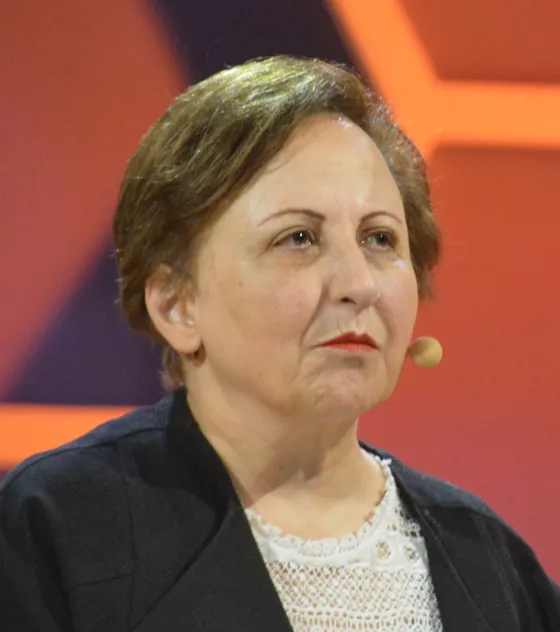
The Achievement
On October 10, 2003, the Norwegian Nobel Committee announced that Shirin Ebadi of Iran would receive the Nobel Peace Prize "for her efforts for democracy and human rights. She has focused especially on the struggle for the rights of women and children."
With that announcement, Ebadi became the first Muslim woman to win any Nobel Prize and the first Iranian to receive one in any category. She was also the 100th Nobel Peace Prize laureate in the award's history.
She was the sixth Muslim overall to receive a Nobel Prize. The five before her: Anwar Sadat (Peace, 1978), Abdus Salam (Physics, 1979), Naguib Mahfouz (Literature, 1988), Yasser Arafat (Peace, 1994), and Ahmed Zewail (Chemistry, 1999). A note on Salam: Pakistan's government declared Ahmadi Muslims to be non-Muslim under Pakistani law in 1974, and some sources exclude him from this count on those grounds. Salam's Nobel epitaph originally read "First Muslim Nobel Laureate" before Pakistani authorities had the word "Muslim" removed. International sources generally include him. The dispute is worth noting rather than hiding.
The Iranian government's response ranged from dismissive to hostile. President Mohammad Khatami said the Nobel Peace Prize "was not very important" and that science and literature prizes were the ones that counted. State television did not broadcast the December ceremony. Conservative newspapers called the award an insult to Islamic countries, or framed it as a Western anti-religious campaign. When Ebadi returned to Tehran, crowds of supporters met her at the airport.
From Judge to Clerk
Shirin Ebadi was born on June 21, 1947, in Hamadan, Iran, and raised in Tehran. She entered the University of Tehran's law faculty in 1965, earned her law degree in 1969, and completed a doctorate in law in 1971. She passed the qualifying exams to serve as a judge immediately after a six-month internship, formally appointed in March 1969. She was among the first cohort of women in Iranian history to serve on the bench, a position made possible only by the Family Protection Law of 1967 and its 1975 expansion.
By 1975, at 28 years old, she had risen to president of the Tehran City Court, one of the most senior judicial roles a woman had held in Iranian history.
When Ayatollah Khomeini came to power, the new Islamic Republic ruled that women could not serve as judges under Islamic law as interpreted by the new government. Ebadi and every female judge in Iran were removed from the bench. The specific cruelty of what followed: she was reassigned to clerical duties in the same court she had presided over. Rather than accept that demotion, she petitioned for early retirement.
She was then locked out of legal practice entirely for over a decade. Her license to practice law was not restored until 1992. During those thirteen years, she wrote on law and children's rights. When she was finally permitted back into the profession, she did not return to a quiet practice. She started taking the cases no one else would touch.
The Cases That Defined Her Career
The case that put Ebadi in front of the Iranian public was that of Arian Golshani, a nine-year-old girl beaten to death by her father and stepbrother. The autopsy documented more than 100 broken bones, cigarette burns, and severe malnutrition. Arian's mother had appeared before the court before her daughter's death to report abuse and beg for custody. Under Iranian law at the time, custody defaulted to the father in nearly all circumstances, with no mechanism to override that default even when abuse was documented. The mother's pleas were dismissed.
Ebadi represented the mother and turned the case into a public campaign for legal reform. It generated widespread coverage inside Iran. The resulting parliamentary changes to custody statutes were incomplete, giving judges discretion rather than mandating protection, but the case demonstrated what strategic litigation could accomplish even in a legal system stacked against the outcome.
The other case that defined her career was more dangerous. Between 1988 and 1998, more than 80 Iranian writers, translators, poets, and political activists were killed or disappeared in what became known as the Chain Murders. The pattern broke into public view in late 1998 when opposition leader Dariush Forouhar and his wife Parvaneh Eskandari Forouhar were stabbed to death in their home, followed within weeks by the murders of several dissident writers.
Ebadi represented the Forouhar family and other victims. The investigation eventually traced the murders to a unit within Iran's Ministry of Intelligence, led by an official named Saeed Emami, who allegedly committed suicide in custody before trial. Ebadi later said she had discovered, while reviewing case files, that she was on the list of targets herself. Her scheduled assassination had been postponed until after Ramadan, at which point the perpetrators were arrested.
She said this publicly. She kept working.
In 2001, Ebadi co-founded the Defenders of Human Rights Center (DHRC) alongside four other Iranian lawyers: Abdolfattah Soltani, Mohammad Seifzadeh, Mohammad Ali Dadkhah, Mohammad Sharif, and Mehdi Afsharzadeh. The center provided legal representation for political prisoners, women, minorities, and bloggers prosecuted for their writing. It became the most significant independent human rights organization operating inside Iran.
Islam and Human Rights: Ebadi's Framework
The Norwegian Nobel Committee described Ebadi in its 2003 presentation speech as "a dangerous woman" in the eyes of her opponents. The committee explained why: "She stands for the view that the norms of democracy and human rights are not culturally specific or Western, but are universal. She is an advocate of dialogue between cultures. She is not a rebel without a cause, but a lawyer who works within the system."
That last point was deliberate. The intellectual position Ebadi held throughout her career is specific and distinct from both secular critics and conservative clerics, and it is worth stating clearly rather than summarizing vaguely.
Her argument was not that religion is irrelevant to human rights. Her argument was that the version of Islam used by the Iranian state to suppress women's rights is a political choice, not an inevitable reading of the texts. She drew a direct line: the discriminatory treatment of women in Islamic-governed states "has its roots in the patriarchal and male-dominated culture prevailing in these societies, not in Islam."
In her 2003 Nobel lecture, she addressed the claim that "democracy and human rights are not compatible with Islamic teachings" directly, calling it a pretext for despotism rather than an accurate reading of the faith. She cited the first word revealed to the Prophet as evidence: "Recite." A religion whose first instruction is to read cannot be inherently opposed to knowledge, expression, or pluralism.
This framework had strategic implications beyond theology. By grounding her legal arguments in Iranian law and Islamic jurisprudence rather than external Western frameworks, she denied the government its easiest counter-argument. She was not an outsider imposing foreign values. She was a trained Iranian lawyer with a doctorate from the University of Tehran, arguing that the government was misapplying its own stated principles.
At a UN press conference in 2004, she said this was deliberate. Working within the system removed the grounds for dismissing her work as foreign interference. It also made the work more dangerous, because she could not be easily categorized as a cultural threat and had to be addressed on the merits.
The Nobel Ceremony and What It Signaled
The December 10, 2003, ceremony in Oslo City Hall contained one detail the Iranian press did not miss. Ebadi appeared without the hijab she would have been legally required to wear inside Iran. It was the first time she had appeared at a major international public event without it. She stated she was following Norwegian law, not Iranian law.
The conservative Iranian press responded as expected. State radio mentioned the award as the last item in its news bulletin. State television did not broadcast the ceremony at all. But when Ebadi returned to Tehran, crowds of supporters met her at the airport.
The gap between those two reactions, the official dismissal and the popular reception, was the political reality the Iranian government had to manage for the next six years.
Exile
The 2009 Iranian presidential election, widely believed to have been rigged, triggered the Green Movement protests. The crackdown that followed was systematic. Ebadi was outside Iran when the election occurred. Colleagues recommended she not return. She went to the UN instead.
She did not go back. She has lived in London since.
The government moved against her assets in November 2009. Iranian Revolutionary Court officials seized the contents of her bank safety deposit box: her Nobel Peace Prize medal, her diploma, her Legion d'honneur awarded by France, and a ring from Germany's journalists' association. Norway's Foreign Minister Jonas Gahr Store issued a public statement: "This is the first time a Nobel Peace Prize has been confiscated by national authorities." The Norwegian Nobel Committee confirmed it was unprecedented in the 108-year history of the prize. Iran's foreign ministry first denied the confiscation had occurred, then criticized Norway for interfering in Iranian affairs. The medal was eventually returned following international pressure.
The harassment extended to her family. On December 29, 2009, her sister Noushin Ebadi was detained, widely understood as a pressure tactic. Her husband was arrested and forced to give a public interview claiming she had been unfaithful. Ebadi stated publicly the statement was coerced.
A government that would confiscate a Nobel Peace Prize medal from a safety deposit box understood exactly what kind of threat Ebadi represented.
A Pattern: Muslim Women and the Peace Prize
Every Muslim woman who has won a Nobel Prize has won it in the Peace category. As of 2026, no Muslim woman has won in physics, chemistry, medicine, literature, or economics.
The four Muslim women Nobel Peace laureates, and what they had in common:
- Shirin Ebadi (Iran, 2003): Human rights lawyer, forced into exile in 2009. Received her prize while still inside Iran, under pressure.
- Tawakkol Karman (Yemen, 2011): Journalist and women's rights activist, briefly imprisoned during the Arab Spring. Co-winner with Ellen Johnson Sirleaf and Leymah Gbowee.
- Malala Yousafzai (Pakistan, 2014): Survived a Taliban assassination attempt that required facial reconstruction surgery. Living in exile in the UK. Youngest Nobel laureate ever at 17.
- Narges Mohammadi (Iran, 2023): Vice president of the DHRC that Ebadi co-founded. Sentenced to 31 years in prison and 154 lashes. Was in Evin Prison when the prize was announced.
The Ebadi-Mohammadi connection runs through the same organization, two decades apart. Mohammadi joined the DHRC in 2003, the same year Ebadi won her prize. The two Nobel Peace Prizes trace a single thread of Iranian human rights work through a single institution, from founder to successor.
Three of the four laureates are from countries under authoritarian Islamic-majority governments. All four were in active conflict with state power at the time of their award. The Peace category recognizes political courage. Political courage is what these women had in abundance, and in most cases, what they paid for with their freedom or safety.
The absence of Muslim women from other Nobel categories involves separate questions about access to education, research funding, and academic infrastructure in majority-Muslim countries. Those are real structural gaps. They do not diminish what the Peace Prize pattern shows: that when Muslim women reach the highest level of international recognition for their work, it is because they refused to stop when governments told them to.
The Work Continues
Ebadi has not stopped from London. Her memoir, "Iran Awakening" (2006, co-written with Azadeh Moaveni), covers her life from childhood through the Nobel Prize and remains the primary English-language account of the events in her own words. "The Golden Cage" (2011) examines how political conditions shape individual lives through the story of three Afghan brothers.
When Mahsa (Jina) Amini died in the custody of Iran's morality police on September 16, 2022, triggering the Woman, Life, Freedom movement, Ebadi was 75 years old and based in London. She became one of the most prominent international voices supporting the protests. She described Amini's death as "a rebirth" and called on international institutions to hold the Iranian government accountable. Of the slogan "Woman, Life, Freedom," she observed that it captured exactly the argument she had been making from inside Iranian courtrooms for decades.
In 2023, her successor at the DHRC, Narges Mohammadi, won the Nobel Peace Prize while imprisoned in Evin. The prize went to a woman who had joined the organization Ebadi built, doing the work Ebadi trained a generation to do, inside the country Ebadi was forced to leave. The Norwegian Nobel Committee did not need to say explicitly that the 2023 prize was also about Ebadi's legacy. The institutional connection made it clear.
As of 2026, Ebadi remains in exile. She has given no indication of returning while the Islamic Republic is in power. She has continued writing, speaking, and advocating from abroad. The government that seized her medal and detained her sister has not succeeded in making her quiet.
Frequently Asked Questions
Who was the first Muslim woman to win the Nobel Prize?
Shirin Ebadi of Iran, who won the 2003 Nobel Peace Prize. She was also the first Iranian Nobel laureate in any category, and the 100th Nobel Peace Prize laureate overall.
Was Ebadi the first Muslim Nobel laureate?
No. She was the sixth. The five before her were Anwar Sadat (Peace, 1978), Abdus Salam (Physics, 1979), Naguib Mahfouz (Literature, 1988), Yasser Arafat (Peace, 1994), and Ahmed Zewail (Chemistry, 1999). The count of Abdus Salam is contested: Pakistan declared Ahmadi Muslims non-Muslim by law in 1974, and his Nobel epitaph originally read "First Muslim Nobel Laureate" before Pakistani authorities had the word removed. International sources generally include him.
What did Shirin Ebadi win the Nobel Prize for?
The Norwegian Nobel Committee cited her "efforts for democracy and human rights," with particular focus on the rights of women and children in Iran.
Was Shirin Ebadi the first female judge in Iran?
She was among the first cohort. She was appointed as a judge in March 1969 after completing her law degree at the University of Tehran, and completed a doctorate in law there in 1971. She became president of the Tehran City Court by 1975. After the 1979 Islamic Revolution, the new government ruled that women could not serve as judges, and Ebadi was demoted to a clerical role in the same court she had presided over.
Why was Ebadi's Nobel medal confiscated?
In November 2009, following Iran's disputed presidential election and the resulting crackdown, Iranian Revolutionary Court officials seized the contents of Ebadi's bank safety deposit box, including her Nobel medal, her diploma, and other awards. Norway's Foreign Minister and the Norwegian Nobel Committee both described it as the first time in 108 years of Nobel Prize history that a national government had confiscated a laureate's medal. It was returned following international pressure.
Who co-founded the Defenders of Human Rights Center with Ebadi?
Ebadi founded the DHRC in 2001 alongside four other Iranian lawyers: Abdolfattah Soltani, Mohammad Seifzadeh, Mohammad Ali Dadkhah, Mohammad Sharif, and Mehdi Afsharzadeh. The center was raided and shut down by Iranian security officials in December 2008.
Where does Shirin Ebadi live now?
In exile in London, since 2009. She has continued her advocacy work from abroad and has not returned to Iran.