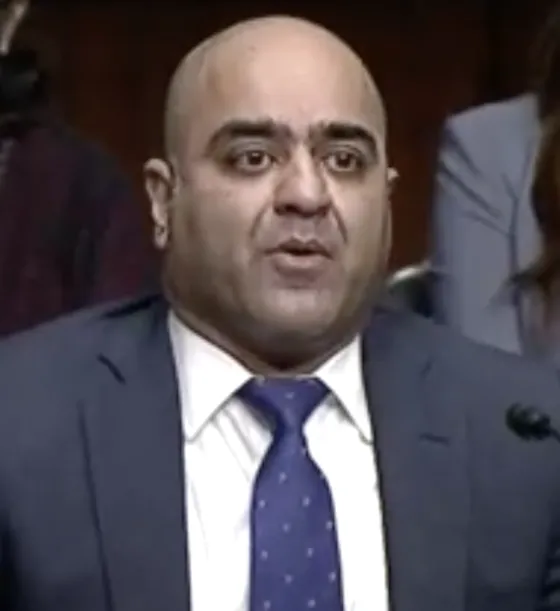
The Achievement
On June 10, 2021, the United States Senate confirmed Zahid Nisar Quraishi as a U.S. District Judge for the District of New Jersey by a vote of 81-16. He became the first Muslim to hold an Article III federal judgeship in the history of the United States. His judicial commission followed twelve days later, on June 22, 2021.
The word "Article III" is doing specific work here. Article III of the U.S. Constitution creates the federal judiciary and specifies that judges "shall hold their Offices during good Behavior," language interpreted to mean lifetime tenure. These judges can be removed only through congressional impeachment, a process that has occurred a handful of times in American history. Their salaries cannot be reduced by Congress while they serve, a protection designed to insulate them from political pressure.
This distinguishes Article III judges from magistrate judges, who are appointed by district courts (not the president), serve eight-year renewable terms, and lack these constitutional protections. Mustafa Kasubhai had served as a federal magistrate judge in Oregon since 2018. That position placed him in a federal courthouse, but not under Article III. When Quraishi was confirmed in 2021, it was the first time a Muslim American had crossed into the constitutionally protected, lifetime category.
The 81-16 confirmation margin was notably bipartisan. In a period when judicial confirmations had become reliably partisan battles, having roughly seventeen Republicans cross party lines to vote yes reflected genuine cross-aisle support for Quraishi's qualifications.
An Immigrant Family's Arc
Zahid Quraishi was born in New York City in 1975 and raised in Fanwood, New Jersey, a small borough in Union County. His parents, Dr. Nisar A. Quraishi and Shahida P. Quraishi, had emigrated from Pakistan. His father arrived in New York in 1970, part of the professional immigration wave that followed the Immigration and Nationality Act of 1965, which eliminated the national-origin quotas that had sharply restricted immigration from Asia for decades. Dr. Nisar Quraishi built a medical practice in New Jersey and continued seeing patients until his death in April 2020 from complications related to COVID-19. He did not live to see his son's confirmation.
Zahid graduated from Scotch Plains-Fanwood High School in 1993. He went on to earn his B.A. from John Jay College of Criminal Justice, part of the City University of New York system, in 1997. He received his J.D. from Rutgers Law School in 2000.
Military Service: JAG Corps, Two Wars, a Bronze Star
In June 2003, Quraishi left private practice to join the U.S. Army Judge Advocate General's Corps. He has said this decision was shaped by the aftermath of September 11, 2001. He was commissioned as an officer and stationed in Germany.
His first Iraq deployment came in early 2004, to Tikrit, during the early phase of Operation Iraqi Freedom. He advised commanders on detainee operations, rules of engagement, and military justice. His second deployment came in August 2006, to Ramadi. In 2006, Ramadi was one of the most violent assignments in the entire war: a stronghold for Al-Qaeda in Iraq, and simultaneously the site of the "Ramadi Awakening" that would become a key counterinsurgency turning point. Quraishi served there as a JAG officer, applying legal analysis to operational decisions in a combat environment.
He was discharged in 2007 at the rank of Captain. His decorations include the Bronze Star and the Combat Action Badge. The Combat Action Badge is awarded specifically to soldiers who have engaged in active ground combat, confirming direct front-line exposure.
The JAG Corps role is worth clarifying. Quraishi was a military lawyer, not a military intelligence officer. His work touched on intelligence-adjacent legal matters (detainee operations, interrogation law) but his function was legal advisory, not intelligence gathering. The distinction matters for accuracy.
From Courthouse to Prosecution to Defense
After Rutgers Law, Quraishi clerked for Judge Edwin Stern of the New Jersey Superior Court, then joined LeBoeuf, Lamb, Greene & MacRae as a litigation associate in Newark. He left that position to enlist. After his 2007 military discharge, he joined the U.S. Attorney's Office for the District of New Jersey as an Assistant U.S. Attorney.
His time at the U.S. Attorney's Office ran from 2008 to 2013, covering the Special Prosecutions Division, the Organized Crime Drug Enforcement Task Force, and the Government Fraud Unit. He prosecuted white-collar crime, public corruption, financial fraud, and narcotics cases. One of his notable prosecutions was that of New Jersey State Senator Wayne Bryant, who was convicted of honest services mail fraud, bribery, and extortion.
In 2013, Quraishi moved to Riker Danzig LLP in Morristown, New Jersey, where he eventually chaired the White Collar Criminal Defense and Investigations practice group. His defense work covered securities violations, healthcare fraud, money laundering, computer crimes, environmental cases, and tax matters. In 2019, he became the firm's first Chief Diversity Officer.
On June 3, 2019, Quraishi was appointed as a U.S. magistrate judge for the District of New Jersey, becoming the first Asian American on the federal bench in that district. He served in that capacity until his Article III confirmation in 2021.
The Nomination and What the Vote Reflected
President Biden formally sent Quraishi's nomination to the Senate on April 19, 2021, after announcing his intent on March 30. Senator Cory Booker had recommended Quraishi for the position and was publicly supportive throughout the process. Both of New Jersey's senators, Booker and Bob Menendez, applauded the nomination.
The 81-16 confirmation vote on June 10, 2021, carried meaning beyond the margin. The Biden era had been marked by near-party-line judicial confirmations. Quraishi's vote was different: with 16 Republicans opposing, that still left a substantial Republican contingent voting yes. The American Bar Association had rated him "well qualified," its highest rating, which gave cross-partisan cover for Republicans who supported him on credentials alone.
His religion, notably, was not the organizing frame of the confirmation fight. This is a meaningful contrast with Keith Ellison's 2006 election to Congress as the first Muslim member. Ellison's swearing-in on the Quran prompted a national controversy, including a letter from Congressman Virgil Goode warning against what he characterized as the Islamization of America. Quraishi's confirmation generated no equivalent controversy. The 16 no votes appear to have focused on his legal record and judicial philosophy rather than his faith. Whether this reflects changed attitudes, different political dynamics, or simply the lower public visibility of a district court confirmation is difficult to say with certainty. But the contrast is real.
State Courts, Federal Courts, and the Distinction That Matters
Quraishi was the first Muslim Article III federal judge, but Muslim judges had broken ground at the state level before him. Halim Dhanidina, an Ismaili Shiite of Gujarati Indian heritage, was appointed by California Governor Jerry Brown to the Los Angeles Superior Court in May 2012, becoming the first Muslim judge in California. In August 2018, Brown elevated Dhanidina to Division Three of the California Court of Appeal, making him the first Muslim appellate-level judge in the United States at any level, and the first South Asian American on the California Court of Appeal.
The federal-versus-state distinction matters because of what Article III protection actually means. State judges serve under varying mechanisms: some are elected, some are appointed to fixed terms, some face retention elections. Federal Article III judges hold their positions for life. A state court judgment that a Muslim jurist served on the California bench, however significant in its own right, does not carry the same institutional permanence as a lifetime appointment to the federal judiciary. Quraishi's 2021 confirmation placed a Muslim jurist in a position designed by the Constitution to be insulated from political cycles.
The Three Who Followed
Between 2021 and 2024, three more Muslim Americans received Article III lifetime appointments, all under President Biden.
Nusrat Jahan Choudhury was confirmed to the U.S. District Court for the Eastern District of New York on June 15, 2023, by a 50-49 vote. She became the first Muslim woman and first Bangladeshi American to hold an Article III judgeship. Her background was civil rights litigation: she had served as Legal Director of the ACLU of Illinois after more than a decade at the national ACLU, where she was Deputy Director of the Racial Justice Program for seven years.
Mustafa T. Kasubhai, who had served as a federal magistrate judge in Oregon since 2018, was elevated to an Article III position in the District of Oregon, confirmed by the Senate on November 19, 2024, by 51-44. He became the first Muslim American lifetime judge in Oregon.
Amir Ali was confirmed to the U.S. District Court for the District of Columbia on November 20, 2024, by 50-49. Born in Kingston, Ontario to Egyptian-Canadian parents, he was a Harvard Law School professor and director of the MacArthur Justice Center before his confirmation, making him the first Muslim and Arab American judge on the D.C. federal bench. He had argued before the U.S. Supreme Court at age 30.
The Barrier That Has Not Fallen
Four Muslim Americans now sit on the federal district bench. None sit on the federal courts of appeals. None have served on the U.S. Supreme Court.
The gap at the circuit level is not for lack of trying. In November 2023, President Biden nominated Adeel Mangi, a Pakistani American litigation partner, to the Third Circuit Court of Appeals. A Third Circuit seat covers New Jersey, Pennsylvania, and Delaware; it is a court that sets binding precedent for millions of people. The American Bar Association rated Mangi "well qualified." His confirmation would have made him the first Muslim American on any federal appellate court.
It did not happen. Democratic Senators Catherine Cortez Masto, Joe Manchin, and Jacky Rosen joined Republican opposition, with some objectors pointing to Mangi's participation in a Muslim lawyers' conference and alleged associations with pro-Palestinian causes. Mangi and his supporters characterized the opposition as Islamophobic. Senate Majority Leader Chuck Schumer ultimately withdrew Mangi's nomination as part of a deal to accelerate other district court confirmations before the end of the 118th Congress. The nomination expired on January 3, 2025.
The contrast with Quraishi's 81-16 confirmation is sharp. A district court nomination sailed through with significant bipartisan support. A circuit court nomination, covering a wider geographic jurisdiction and carrying greater precedential weight, could not survive. The circuit and Supreme Court barriers remain intact.
Frequently Asked Questions
Who was the first Muslim federal judge in the United States?
Zahid Quraishi, confirmed as U.S. District Judge for the District of New Jersey on June 10, 2021, by a vote of 81-16.
What is an Article III judge?
A federal judge appointed under Article III of the U.S. Constitution, with lifetime tenure and salary protection from Congress. This is distinct from magistrate judges (fixed terms, appointed by district courts) and other federal judicial officers.
Was Zahid Quraishi in the military?
Yes. He served as a JAG Corps officer in the U.S. Army from 2003 to 2007, including two deployments to Iraq. He received the Bronze Star and Combat Action Badge, among other decorations.
Has there been a Muslim Supreme Court justice?
No. As of March 2026, no Muslim has served on the U.S. Supreme Court or any federal circuit court of appeals.
Who nominated Zahid Quraishi?
President Joe Biden. He announced his intent to nominate Quraishi on March 30, 2021, and formally sent the nomination to the Senate on April 19, 2021.
How many Muslim Article III federal judges are there?
Four, as of March 2026: Zahid Quraishi (District of New Jersey, 2021), Nusrat Jahan Choudhury (Eastern District of New York, 2023), Mustafa T. Kasubhai (District of Oregon, 2024), and Amir Ali (District of Columbia, 2024). All four were confirmed under President Biden.