The Achievement
On February 5, 2014, Marvel Comics published Ms. Marvel #1, starring Kamala Khan: a sixteen-year-old Pakistani-American Muslim from Jersey City, New Jersey, who discovers she has shape-shifting superpowers and takes on the identity of her idol. It was the first time in Marvel's history, or DC's, that a Muslim character had ever headlined their own ongoing comic series.
The distinction requires care. Kamala was not the first Muslim character in superhero comics. Sooraya Qadir, the X-Man known as Dust, had been in print since December 2002. Monet St. Croix had appeared in Marvel titles since 1994. What neither had ever received, and what Kamala now had, was the top billing on her own series: her name on the cover, her story the whole book, her identity the reason someone picked it up.
The industry expected cautious sales. Instead, the first issue sold out immediately, went through at least seven printings, outsold its print run digitally at a ratio no Marvel title had achieved before, and eventually won a Hugo Award. The character who came from a Pakistani-American editor telling stories about her New Jersey childhood had found an audience that the direct market had been ignoring for decades.
The Precise "First": What Kamala Actually Was
Before going further, the record needs to be precise about what this first actually was, because it is commonly overstated and the accurate version is still significant.
Sooraya Qadir, a Pashtun Muslim from Kandahar, Afghanistan, first appeared in New X-Men #133 in December 2002, created by Grant Morrison and Ethan Van Sciver. Her mutant ability lets her transform into a sandstorm-like form. Her Muslim faith is central to her characterization: she wears a niqab and abaya in civilian life, and her religious identity is not incidental to who she is. She debuted twelve years before Kamala and has never headlined her own ongoing series.
Monet St. Croix appeared even earlier, in Generation X #1 in November 1994. Her Muslim identity was later confirmed in a 2011 X-Factor issue, making it a retroactive addition rather than an original character element.
There was also Josiah X, a Muslim minister and minor character sometimes described as a "Muslim Captain America," though he was never more than a supporting figure.
What Kamala Khan was, genuinely and first: the first Muslim character to headline an ongoing series at either Marvel or DC Comics. She was also the first South Asian-American Marvel character with her own book. Those firsts are real, documented, and commercially proven.
The People Who Made Her: The Creation Story
The origin of Kamala Khan is not a corporate diversity initiative. It is a story about two people with specific backgrounds, telling stories to each other over lunch.
Sana Amanat grew up in Montville, New Jersey, the child of Pakistani immigrants. She became an editor at Marvel and, over time, began talking with fellow editor Stephen Wacker about what it was like growing up Muslim in a predominantly white New Jersey suburb. The stories she told were funny, specific, and human: the friction of navigating two cultures, the particular experience of being visibly different in a place built around invisibility, and finding no reflection of that experience in the comics she loved as a kid. Wacker thought those stories were compelling enough to become a character. He was right.
The pair brought in G. Willow Wilson, a writer whose credentials for the project were specific in ways that mattered. Wilson is a white American who converted to Islam in 2003, on a flight to Cairo, shortly before graduating from Boston University. She had spent years writing about her faith, including a memoir and several critically praised comics. She was not Pakistani-American and had not grown up in New Jersey, but she lived in the Muslim-American community and understood it from the inside. When Amanat called her and described the concept, Wilson's response was immediate: "Yes."
The artist Adrian Alphona brought a visual sensitivity to the Jersey City streets and the texture of Kamala's family home that grounded the book's more fantastical elements. The costume was designed by Jamie McKelvie, drawing on the shalwar kameez as a reference point for the silhouette.
One key decision defined the character's authenticity: Kamala does not wear a hijab. This was deliberate. Amanat and Wilson discussed it directly and concluded that most teenage Pakistani-American girls in New Jersey do not wear one. Making Kamala a hijabi would have made her more obviously "Muslim" as a symbol while making her less real as a person. Their stated goal from the start was "a character who felt like a real person, not like a checklist." The religion is part of her life, present in how she thinks and what she values, but it is not a costume or a marker. She hates gym class. She writes Avengers fan fiction. She sneaks out to a party her parents told her not to attend, which is precisely when the Terrigen Mists hit Jersey City.
Kamala's Powers: The Inhuman Explanation
In the comics, Kamala is outside past curfew, sneaking to a party her parents forbade, when Terrigen Mists roll through Jersey City. The mists, released into Earth's atmosphere during the Infinity storyline, activate dormant Inhuman DNA in anyone who carries it. Kamala carries it, and she emerges from a protective chrysalis with polymorph abilities: she can reshape any part of her body, enlarging or shrinking limbs at will. Her signature move, "embiggen," involves growing her fists to enormous size. It is equal parts joyful and effective, which fits her personality exactly.
Her powers were later layered with additional complexity. During the Krakoan Era of X-Men comics, it was revealed that Kamala also has mutant heritage, and that her Inhuman powers may have suppressed her mutant abilities. This dual heritage connected her to both the Inhumans and the X-Men storylines, broadening her role in the larger Marvel universe.
The MCU changed her powers substantially. Rather than the physical shape-shifting of the comics, the Disney+ series gave Kamala the ability to harness cosmic energy through a magical bangle called the Noor Bangle, tied to Djinn mythology and her Pakistani heritage. She creates hard light constructs, including "embiggened" fists, but the mechanism is entirely different. Kevin Feige explained the change as a timeline issue: the Inhuman storyline in the comics developed in a context that did not align with where the MCU stood in 2022. G. Willow Wilson publicly approved the adaptation, noting that a different medium requires its own logic. The Disney+ series also confirmed Kamala as a mutant in the MCU through a post-credits scene using the classic X-Men musical sting.
Sales That Changed the Conversation
The comics industry in 2014 operated on a set of assumptions about who bought superhero comics and what they wanted. Ms. Marvel challenged those assumptions in ways that were hard to dismiss because they showed up in the numbers.
Ms. Marvel #1 sold out and went to a second printing within days of release. By the end of 2014, the first issue had reached at least seven printings. That was exceptional. What was unprecedented was the digital performance: at a time when most Marvel titles sold roughly 10 to 20 digital copies for every 100 in print, Ms. Marvel #1 sold digital and print copies at essentially a 1:1 ratio. Sana Amanat confirmed the series became Marvel's number-one digital seller. The Vol. 1 trade collection, No Normal, reached number two on the New York Times Best Seller list for paperback graphic books in November 2014. By August 2018, nine volumes of trade paperback collections had sold half a million copies combined.
Comics scholar Mel Gibson, writing about the series, observed that it "absolutely leapt in sales to what could be considered non-traditional comic book buyers, such as females, Muslims, or Pakistani-Americans," and that "the idea of who reads comics and how they read them was changing." The market had not been serving those readers. Ms. Marvel proved they existed, they spent money, and they would show up for a character that reflected them.
The Hugo Award and the Puppy Wars
In August 2015, at the 73rd World Science Fiction Convention in Spokane, Washington, Ms. Marvel Vol. 1: No Normal won the Hugo Award for Best Graphic Story. It defeated Rat Queens Vol. 1, Sex Criminals Vol. 1, Saga Vol. 3, and Reduce Reuse Reanimate by Carter Reid.
The Hugo is voted on by science fiction and fantasy fans who purchase supporting or attending memberships to Worldcon, not by industry professionals. A fan vote carries a particular kind of weight: it reflects what actual readers valued, not what an awards committee decided.
The 2015 Hugos were the first year significantly affected by the "Puppy" campaigns: coordinated efforts by conservative groups called Sad Puppies and Rabble Puppies, which successfully placed their preferred slates onto several Hugo nomination ballots in deliberate opposition to what they characterized as politically motivated diversity choices. The campaign generated significant controversy within the science fiction community. In this context, Ms. Marvel's win was widely read as a direct counter-signal from the broader fan community: the readers who voted were not the ones the Puppy campaigns claimed to speak for.
Iman Vellani and the Casting That Made Itself
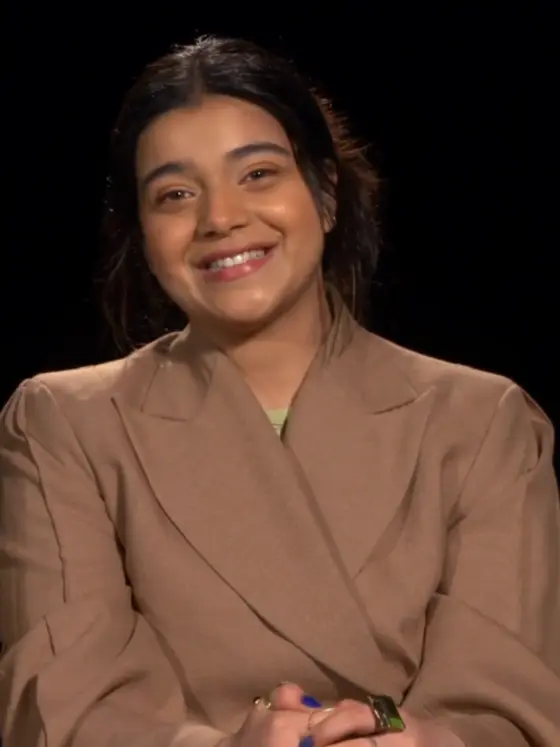
Iman Vellani was born August 12, 2002, in Karachi, Pakistan. Her family moved to Canada when she was one year old. She was raised as an Ismaili Muslim in Markham, Ontario, attended high school there, and had no professional acting experience when her aunt forwarded her a casting call for a new Marvel Disney+ series in 2020.
She submitted a self-tape. Then she auditioned in Los Angeles. Then she had two screen tests: one in person in February 2020 and one over Zoom in June 2020, after COVID had shut down in-person production.
Co-creator Sana Amanat, who served as executive producer on the series, recalled Vellani's Zoom screen test: "She showed me every corner of her room, and it was covered with Avengers posters. And then said, 'Oh wait, I'm not done,' opened up her closet, and there was more Marvel everywhere." Kamala Khan is a fictional teenage Pakistani-American Muslim who is obsessed with the Avengers, specifically with Carol Danvers. Iman Vellani is a real Pakistani-Canadian Muslim who was, before her casting, obsessed with the Avengers. The parallel is not subtle, and it was not manufactured.
The Ms. Marvel Disney+ series premiered June 8, 2022, and ran for six episodes through July 13. It filmed in Atlanta, New Jersey, and Thailand. On Rotten Tomatoes, it holds a 98% approval rating from 303 reviews. Critics specifically noted the visual approach: the series used animated graffiti overlays, illustrated text, and graphic novel-style visual inserts to create a look unlike anything else in the MCU. The technique was widely praised as the kind of formal invention that superhero television rarely attempts.
The Marvels and What the Box Office Doesn't Tell You
The Marvels, released November 10, 2023, brought Kamala to the big screen alongside Carol Danvers (Brie Larson) and Monica Rambeau (Teyonah Parris). It opened to $47 million domestically, the lowest opening weekend for an MCU film at the time of release. The second weekend saw a 78% drop, also an MCU record.
Reading that performance as a referendum on Kamala Khan specifically misreads the data. The film followed one of the most concentrated periods of MCU content in history: multiple Disney+ series had aired in 2021 and 2022, audience tracking showed widespread confusion about who "The Marvels" referred to, and critics noted that the film required familiarity with several streaming series to fully follow. MCU audience fatigue was a documented phenomenon by late 2023, affecting films across the slate.
Vellani's performance was consistently singled out as the film's standout element even by critics who gave the film mixed reviews. When asked about the box office performance, Vellani replied that it was "Bob Iger's problem," not hers. She has confirmed publicly that Kamala will return in future MCU projects.
Vellani has also crossed into comics herself: she co-wrote The Marvels series in 2023 with Jeremy Whitley, making her one of the rare actors to actively contribute to the source material for their own character.
What the Character Built
A decade after Ms. Marvel #1, the argument Kamala Khan's creators were implicitly making, that a Muslim-American character from New Jersey could carry her own book, sell more digital copies than print, win a Hugo, anchor an MCU Disney+ series, and appear in a theatrical film, has been proven beyond the standard required for proof.
The character worked for the reason Amanat and Wilson always said it would: she felt like a real person. She is a fangirl who writes fan fiction and is genuinely embarrassing about her love for Carol Danvers. She has curfew problems and friend problems and the specific exhaustion of being caught between two cultures that each have only partial claims on who she is. The superpowers are secondary to all of that, which is exactly how it should be.
Sooraya Qadir appeared twelve years earlier and never got her own series. The gap between 2002 and 2014 is not explained by a lack of Muslim readers or a cultural resistance to Muslim characters. It is explained by the industry not trying. Ms. Marvel was the first attempt done at full scale, with full creative commitment, by people who understood the character from the inside. The sales numbers are what happened when that combination finally arrived.
Frequently Asked Questions
Was Kamala Khan the first Muslim superhero in comics?
No. Kamala was the first Muslim character to headline her own ongoing Marvel series, which launched February 5, 2014. The first prominent Muslim character in Marvel Comics was Sooraya Qadir, known as Dust, who appeared in New X-Men #133 in December 2002, twelve years earlier. Monet St. Croix appeared even earlier, in 1994, though her Muslim identity was retroactively established. What Kamala was genuinely first at was the solo headlining role at Marvel (and at any major American comics publisher).
Who created Ms. Marvel (Kamala Khan)?
Kamala was created by editors Sana Amanat and Stephen Wacker, writer G. Willow Wilson, and artist Adrian Alphona, with costume design by Jamie McKelvie. The concept originated with Amanat telling Wacker stories about growing up Pakistani-American and Muslim in New Jersey. Wacker brought Wilson in as writer because of her deep familiarity with the Muslim-American community: she is a white American convert to Islam who converted in 2003 and had written extensively about her faith.
When did Ms. Marvel #1 come out?
February 5, 2014. Kamala's first appearance was earlier: a brief unnamed cameo in Captain Marvel #14 (August 2013), followed by her first full story in All-New Marvel Now! Point One #1 (January 2014). Her solo series, and the historic milestone, began with the February 2014 launch.
Did Ms. Marvel win any awards?
Ms. Marvel Vol. 1: No Normal won the Hugo Award for Best Graphic Story at the 73rd World Science Fiction Convention in Spokane, Washington, in 2015. The Hugo is a fan-voted award, not an industry prize, which gave the win particular significance. The win came during the "Puppy" voting campaigns that actively opposed diversity-forward nominations, making the result a direct expression of broader fan preferences.
Who plays Kamala Khan in the MCU, and how was she cast?
Iman Vellani, a Pakistani-Canadian actress born in Karachi in 2002 and raised as an Ismaili Muslim in Markham, Ontario. She had no professional acting experience. Her aunt forwarded her a casting call for the role in 2020. She submitted a self-tape, flew to Los Angeles to audition, and had two screen tests. Co-creator Sana Amanat, who served as executive producer on the series, recalled Vellani's Zoom screen test: she showed her room, which was covered in Avengers posters, then opened her closet to reveal more Marvel merchandise. For a role playing a character defined by her obsession with the Avengers, no further qualification was necessary.