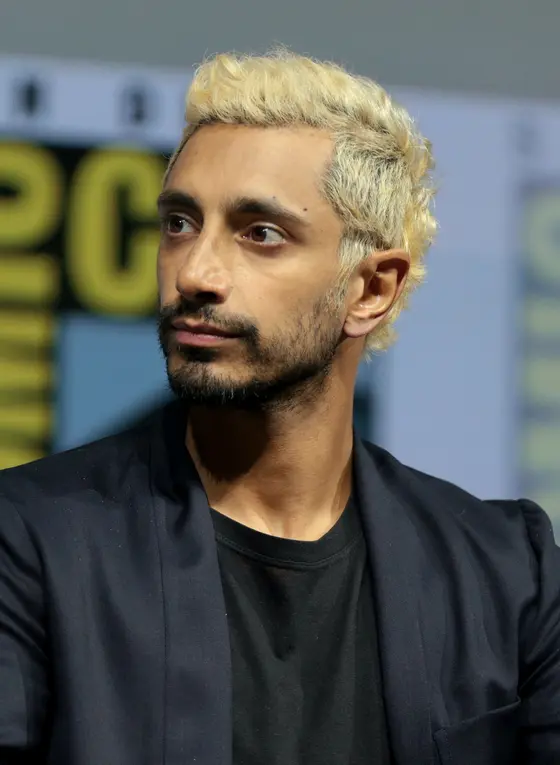
The Achievement
On September 17, 2017, at the 69th Primetime Emmy Awards, Riz Ahmed won Outstanding Lead Actor in a Limited Series or Movie for his role as Nasir "Naz" Khan in HBO's The Night Of. The win made him the first Muslim and first South Asian man to win a lead acting Emmy in the award's history. His competition that night included Robert De Niro, Benedict Cumberbatch, Ewan McGregor, Geoffrey Rush, and John Turturro, his own co-star in the series.
In his acceptance speech, Ahmed said: "I want to say it is always strange reaping the rewards of a story based on real-world suffering, but if this show has shown a light on some of the prejudice in our societies, some of the injustice in our justice system, then maybe that is something." He gave a shout-out to South Asian Youth Action, a youth organization in the Queens neighborhood where his character Naz had grown up, and paid tribute to James Gandolfini, the show's executive producer who had died in 2013: "He's a man I believe single-handedly changed television, and I hope he's proud of us right now."
The Emmy win stands on its own terms, separate from the Oscar milestones that followed. Mahershala Ali had become the first Muslim actor to win an Oscar for Best Supporting Actor (Moonlight) in February of the same year. Ahmed's Emmy in September was in a different awards body, a different category, and for a lead role. Both men were making history in the same award season window, on different tracks.
Naz Khan and The Night Of
The Night Of was an 8-episode HBO limited series that aired in summer 2016, adapted from the British series Criminal Justice. Ahmed played Nasir "Naz" Khan, a Pakistani-American college student living with his immigrant parents in Jackson Heights, Queens. One night, Naz borrows his father's taxi without permission, picks up a young woman named Andrea Cornish, and ends up at her apartment. When he wakes in the morning, she is dead. He is arrested and charged with murder, with no memory of what happened.
The series tracks Naz through the machinery of the American criminal justice system, watching him transform from a cautious, bookish student into someone hardened by incarceration. Ahmed physically transformed for the role, gaining muscle and taking on tattoos as Naz adapted to survive prison. Critics consistently cited the performance as a precise study in internalized trauma and gradual dehumanization. The Hollywood Reporter called it "devastating." Variety called it "one of the great TV performances of the decade."
What made the role significant beyond its craft: Naz is Muslim, but his faith is incidental to the story rather than the subject of it. The Night Of is not a drama about terrorism, radicalization, or Islam. It is a criminal justice drama in which a young Pakistani-American man is caught in a broken system. That choice was unusual for Muslim characters on American television at the time. Naz is not defined by his religion as a threat or a burden. He is simply a young man in an impossible situation, and the show trusts that to be enough.
From Wembley to Oxford to Hollywood
Rizwan Ahmed was born on December 1, 1982, in Wembley, a diverse area of West London with a large South Asian population. His family had emigrated from Karachi, Pakistan. He attended Merchant Taylors' School on a scholarship, then read Philosophy, Politics, and Economics at Christ Church, Oxford, describing the environment there as isolating and elitist. He organized parties celebrating cultures outside the dominant white, black-tie atmosphere. He later trained at the Royal Central School of Speech and Drama.
His music career began before his acting career, on pirate radio in his mid-teens and in freestyle rap battles under the name Riz MC. In 2006, he recorded "Post 9/11 Blues," a satirical track that spread online and drew the attention of UK counter-terrorism officers, who questioned him about it. His debut solo album MICroscope came out in 2011. His hip hop duo Swet Shop Boys, formed with rapper Heems in 2014, released the critically acclaimed album Cashmere in 2016, addressing post-9/11 Muslim life in America and the UK with wit and precision. Pitchfork reviewed it favorably.
His film career developed in parallel. Four Lions (2010), Chris Morris's dark satire about four British jihadists, was a deliberately provocative debut: Ahmed helped humanize characters typically flattened into villains while the film simultaneously critiqued radicalization. The film received BAFTA nominations and established Ahmed as a serious actor willing to take on difficult material. Nightcrawler (2014) and Rogue One: A Star Wars Story (2016), in which he played the defecting Imperial pilot Bodhi Rook, expanded his profile internationally.
In December 2016, when Rogue One opened, Ahmed became the first person to simultaneously hold the number-one position on the Billboard 200 album chart (via the Hamilton Mixtape, featuring his track "Immigrants (We Get the Job Done)") and the number-one position at the box office. That track, with K'naan, Snow tha Product, and Riz MC, won an MTV Video Music Award for Best Fight Against the System.
The Parliament Speech and the Riz Test
Six months before the Emmy win, in March 2017, Ahmed delivered Channel 4's annual diversity lecture at the House of Commons in London. His central argument drew a line between diversity and representation, insisting they are not the same. Diversity can be tokenistic: putting bodies on screen without changing what those bodies are allowed to do or say. Representation means authentic, complex portrayal of experience that reflects reality.
He told Parliament: "When we fail to represent, people switch off. They switch off their telly, they switch off at the ballot box. If we fail to represent, we are in danger of losing people to extremism." He shared personal experiences of racism he had encountered as a recognizable, successful actor. He pointed to the pattern of British-South Asian actors having to move to America to find substantive television roles, describing the irony of being better served by American industry than British.
The speech directly inspired two UK researchers, Sadia Habib and Shaf Choudry, to create the Riz Test. The test asks five questions of any Muslim character in film or television: Is the character portrayed as threatening, as a terrorist, as irrationally angry, as oppressive toward women, or as "the Other"? If a Muslim character does one or more of these things and it goes unchallenged, the work fails. The test is available at riztest.com and functions as an equivalent of the Bechdel Test for Muslim representation in media. That it exists at all, and carries his name, is a form of recognition more durable than most award wins.
Sound of Metal and the Oscar Arc
In Sound of Metal (2020), Ahmed played Ruben Stone, a heavy metal drummer losing his hearing rapidly over the course of the film. He learned American Sign Language and drumming for the role. The film received six Oscar nominations at the 93rd Academy Awards and won two (Best Sound and Best Film Editing). Ahmed's nomination for Best Actor made him the first Muslim in the history of the Academy Awards to be nominated in a lead acting category. He did not win (Anthony Hopkins won for The Father), but the nomination itself was documented as a historic first by NBC News, Arab News, and Al Jazeera.
This milestone is distinct from the Emmy in category, awards body, and outcome. It is also distinct from Mahershala Ali's Oscar wins, which were both in the supporting category. Ahmed's nomination was specifically in the lead role category, where no Muslim actor had been nominated before.
At the 94th Academy Awards in March 2022, Ahmed's short film The Long Goodbye won Best Live Action Short Film. The twelve-minute film, co-written and produced by Ahmed and directed by Aneil Karia, depicts an Asian British family at a pre-wedding celebration before a far-right militia arrives. It is explicitly about the feeling of being unwelcome in the country where you were born. The Oscar win made Ahmed the first Muslim to win an Academy Award for a live-action film (Ali's wins were in acting categories; The Long Goodbye is a filmmaking and producing credit). Ahmed said in his acceptance speech: "We believe that the role of the story is to remind us there is no us and them. There's just us."
The 2021 Muslim Representation Study
In June 2021, Ahmed partnered with USC Annenberg's Inclusion Initiative to commission the first systematic study of Muslim characters in popular film. The study analyzed 200 films from the US, UK, Australia, and New Zealand released between 2017 and 2019. The findings were precise: only 10% of the 200 films had any Muslim character at all; of nearly 9,000 speaking roles across those films, fewer than 2% were Muslim; only 6 of the 200 films had a Muslim in a co-leading role, and only one of those was female; zero animated films included Muslim characters.
Ahmed's response was a "blueprint for Muslim inclusion" addressing studio decision-making, film school admissions and curriculum, and philanthropy. He co-founded a coalition with Mahershala Ali, Ramy Youssef, and others. Through The Pillars Fund, he helped create a fellowship for Muslim artists in film. The study gave quantitative weight to the argument he had been making since at least his 2017 Parliament speech: the absence of Muslim characters from mainstream film was not a random gap but a structural one.
Frequently Asked Questions
Who was the first Muslim to win a lead acting Emmy?
Riz Ahmed was the first Muslim to win a lead acting Emmy Award. He won Outstanding Lead Actor in a Limited Series or Movie at the 69th Primetime Emmy Awards on September 17, 2017, for his role as Nasir "Naz" Khan in HBO's The Night Of. He was also the first South Asian man to win any acting Emmy.
What did Riz Ahmed win the Emmy for?
Riz Ahmed won the Emmy for Outstanding Lead Actor in a Limited Series or Movie for playing Nasir "Naz" Khan in The Night Of, an 8-episode HBO limited series that aired in summer 2016. The character is a Pakistani-American college student charged with murder who transforms over the course of the series as he moves through the American criminal justice system.
Is Riz Ahmed's Emmy win different from Mahershala Ali's Oscar wins?
Yes. They are separate milestones at different awards bodies in different categories. Mahershala Ali became the first Muslim actor to win an Oscar, winning Best Supporting Actor for Moonlight in February 2017 and Green Book in February 2019. Riz Ahmed became the first Muslim to win a lead acting Emmy in September 2017, and in 2021 became the first Muslim nominated for a Best Actor Oscar (a lead role category). Both milestones stand independently.
Has Riz Ahmed won an Oscar?
Yes. At the 94th Academy Awards in March 2022, Ahmed's short film The Long Goodbye won Best Live Action Short Film, making him the first Muslim to win an Oscar for a live-action film as a producer. He was also the first Muslim nominated for the Best Actor (lead role) Oscar, receiving that nomination in 2021 for Sound of Metal. He did not win Best Actor that year.
What is the Riz Test?
The Riz Test is a five-criteria framework for evaluating whether a Muslim character in film or TV is portrayed in a harmful, stereotyped way. Inspired by Riz Ahmed's 2017 Parliament speech on Muslim representation, it was created by researchers Sadia Habib and Shaf Choudry. The test asks whether a Muslim character is portrayed as threatening, as a terrorist, as irrationally angry, as oppressive toward women, or as "the Other," with the test functioning similarly to the Bechdel Test as a practical measurement tool for representation gaps.