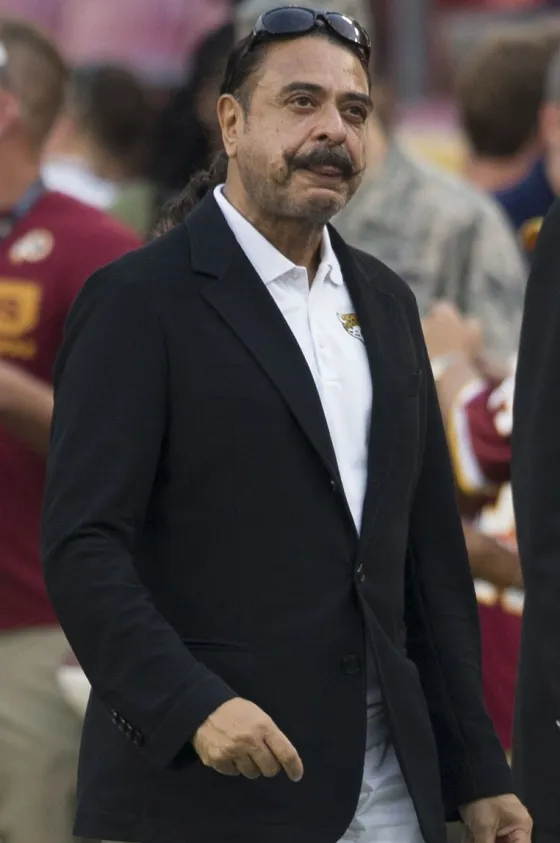
The Achievement
On January 4, 2012, Shahid Khan signed the paperwork making him the owner of the Jacksonville Jaguars. The sale price was $770 million. The NFL owners had already voted 31-0 to approve it on December 14, 2011. Both numbers matter: the unanimous vote signals this was not a close call or a reluctant exception. The league embraced it.
Khan became the first ethnic minority of any background to hold majority ownership of an NFL franchise in the league's 93-year history. He is also Muslim, born in Lahore, Pakistan, and listed in The Muslim 500, the annual publication from the Royal Islamic Strategic Studies Centre identifying the world's most influential Muslims. The NFL itself used the phrase "first ethnic minority" in its official framing. The Muslim dimension is real, documented, and worth stating plainly, even though Khan describes his religious identity as cultural rather than observant.
Forty-five years separated his arrival in America from the moment he owned an NFL team. In 1967, he landed in Illinois with $500 and no connections. His first job paid $1.20 per hour. By 2012, he had built one of the largest privately-held manufacturing companies in North America and bought a professional football franchise that would be worth $3.7 billion a decade later.
From Lahore to Champaign-Urbana
Shahid Rafiq Khan was born on July 18, 1950, in Lahore, Pakistan. His father worked in construction, solidly middle class by Pakistani standards. Khan came to the United States not to escape poverty but to study. He was 16 years old and traveling alone when he arrived at the University of Illinois at Urbana-Champaign in 1967 to pursue a degree in industrial engineering.
His first night cost $2 at the YMCA. His first job, washing dishes at a university dining hall, paid $1.20 an hour. He did not frame these circumstances as hardship. His later comment on the wage was characteristically direct: "$1.20 an hour was more than what 99 percent of the people in Pakistan were making."
While studying, he worked nights at a local auto parts company called Flex-N-Gate. He learned the manufacturing process from the ground up. He also joined Beta Theta Pi fraternity, which he later credited with teaching him how American social and professional networks function, something no classroom covered.
He graduated in 1971 with a Bachelor of Science in Industrial Engineering. He did not leave Champaign-Urbana. He stayed, kept working at Flex-N-Gate after graduation, and spent the next several years developing an idea that would change the direction of his life.
The Invention That Built the Empire
The auto parts industry in the 1970s manufactured bumpers in multiple pieces, then assembled them. Khan saw a better way. In 1978, with $13,000 in personal savings and a $50,000 Small Business Administration loan, he founded Bumper Works in Danville, Illinois.
The core innovation was a one-piece bumper design. Instead of fabricating and assembling multiple components, Bumper Works formed the entire bumper from a single piece of metal. The process was cleaner, faster, and cheaper. It became the industry standard. American automakers adopted it broadly.
Two years later, in 1980, Flex-N-Gate came up for sale. Khan bought the company he had worked for as a student, merged Bumper Works into it, and kept building. He never took it public. Flex-N-Gate has remained entirely private throughout its history, which means there is no stock price or quarterly earnings report, just a manufacturing operation that grew steadily for four decades.
By the time Khan bought the Jaguars, Flex-N-Gate operated dozens of plants across North America. Today it runs 76 plants worldwide, employs more than 27,000 people, and generates over $9 billion in annual revenue. It supplies bumpers and exterior components to Ford, General Motors, Toyota, Fiat Chrysler, and other major automakers. The company that started with one innovation in a Danville, Illinois, facility became one of the largest auto parts suppliers in the world.
Buying the Jaguars
The Jacksonville Jaguars were not the most glamorous franchise in the NFL. Founded in 1995 as an expansion team, the Jaguars had reached two AFC Championship games but had spent much of the 2000s struggling both on the field and financially. Owner Wayne Weaver had been open about the challenges of sustaining a small-market NFL franchise.
Khan entered negotiations in 2011. The agreement was announced on November 29, 2011: $770 million for 100 percent of the franchise. The NFL's ownership committee reviewed the sale, and on December 14, 2011, all 31 other NFL owners voted to approve it unanimously. The transaction closed on January 4, 2012.
The NFL's announcement used the phrase directly: Khan was "the first member of an ethnic minority to own an NFL team." Contemporary coverage from ESPN, CBS News, and the Associated Press carried the same designation. No qualification, no hedging.
From a financial standpoint, the purchase was defensible by any measure. A $770 million investment in an NFL franchise in 2012 was not speculative; NFL revenue-sharing and media rights make ownership structurally profitable. By 2024, Forbes valued the Jaguars at approximately $3.7 billion. The franchise that Khan purchased for $770 million has grown nearly fivefold in a little over a decade.
Muslim Identity: What Khan Has Said
Khan does not present himself as a religious figure. He attends no mosque regularly, does not observe dietary restrictions publicly, and has been characteristically candid about where religion fits in his life. His most widely quoted comment on the subject came in an interview where he was asked directly: "What's your religion? I can tell you, it's Muslim. These are personal, private kinds of things, but I don't believe religion should come between a man and a Bud Light, OK."
That is cultural Muslim identity stated plainly. He is not hiding anything, not performing piety, and not distancing himself from the label. He is Muslim the way many people are: by heritage, by birth, by how he understands his own background, without intensive religious observance defining daily life.
The Royal Islamic Strategic Studies Centre in Amman, Jordan, which publishes The Muslim 500 each year, includes Khan on its list of the world's most influential Muslims. The publication defines "Muslim" broadly, encompassing those who identify with Islam by heritage and those who are observant. Khan's presence on the list provides authoritative published confirmation of his identity beyond his own statements.
Beyond the NFL: An International Sports Empire
Khan did not stop with one franchise. In July 2013, he purchased Fulham F.C. from Mohamed Al Fayed for an estimated £150-200 million, making him one of a small number of American owners of English Premier League clubs. Fulham, based in southwest London, has spent most of its recent history moving between the Premier League and the Championship (England's second division). Khan's ownership has coincided with significant investment in the club's Craven Cottage stadium.
In 2019, his son Tony Khan co-founded All Elite Wrestling, known as AEW, which launched as the first credible competitor to WWE in two decades. Tony serves as AEW president and is the primary creative force behind the promotion. Khan's ownership stake makes AEW part of the family sports portfolio.
No other owner in the world simultaneously holds franchises in the NFL, the English Premier League, and a major professional wrestling promotion. The combination is genuinely without precedent.
What the Story Actually Represents
Shahid Khan's path from dishwasher to NFL owner is sometimes flattened into a generic immigrant success story, which misses what actually happened. He did not simply work hard and get lucky. He identified a manufacturing inefficiency, built a patent around it, used that patent as a foundation to acquire a company, and then ran that company with enough discipline to keep it private for more than 40 years while growing it to a scale most publicly traded companies never reach.
He became a naturalized U.S. citizen in 1991, 24 years after arriving in Champaign-Urbana. He was named to the Carnegie Corporation of New York's "Great Immigrants, Great Americans" class in 2025, which recognizes naturalized citizens who have contributed significantly to American life. The Carnegie recognition sits alongside his Distinguished Alumni status at the University of Illinois and decades of civic investment in Jacksonville, including significant funding for downtown development projects.
In 2025, Forbes ranked him 74th on the Forbes 400 richest Americans, with a net worth of $14.3 billion. He is ranked 178th globally. The number that started everything was $500, the amount in his pocket when he landed in Illinois in 1967.
Frequently Asked Questions
Who was the first Muslim to own an NFL team?
Shahid Khan became the first Muslim to own an NFL team when he purchased the Jacksonville Jaguars on January 4, 2012, for $770 million. The NFL owners voted 31-0 to approve the sale on December 14, 2011. Khan was also the first ethnic minority of any background to hold majority ownership of an NFL franchise in the league's history.
How much did Shahid Khan pay for the Jacksonville Jaguars?
Khan purchased the Jaguars for $770 million, with the sale finalized on January 4, 2012. As of 2024, Forbes values the franchise at approximately $3.7 billion, meaning the team has grown nearly fivefold in value since his purchase.
How did Shahid Khan make his money before buying the Jaguars?
Khan built his fortune through Flex-N-Gate Corporation, a private auto parts manufacturer based in Urbana, Illinois. He arrived in America in 1967, studied industrial engineering at the University of Illinois, and worked at Flex-N-Gate as a student. In 1978, he founded Bumper Works with $13,000 in savings and a $50,000 SBA loan, inventing a one-piece bumper design that became the industry standard. He purchased Flex-N-Gate from his former employer in 1980 and grew it to over $9 billion in annual revenue across 76 global plants and 27,000 employees.
Is Shahid Khan a practicing Muslim?
Khan identifies as Muslim by heritage and culture and has stated his religion is Islam on record. He describes himself as secular in practice. His own quote: "I don't believe religion should come between a man and a Bud Light." He has been listed in The Muslim 500, published annually by the Royal Islamic Strategic Studies Centre, which documents the world's most influential Muslims.
What other sports teams does Shahid Khan own?
In addition to the Jacksonville Jaguars (NFL), Khan purchased Fulham F.C. of the English Premier League in July 2013. His son Tony Khan founded All Elite Wrestling (AEW) in 2019, with Shahid holding an ownership stake. No other owner in the world simultaneously controls franchises in the NFL, the Premier League, and a major professional wrestling organization.