The Achievement
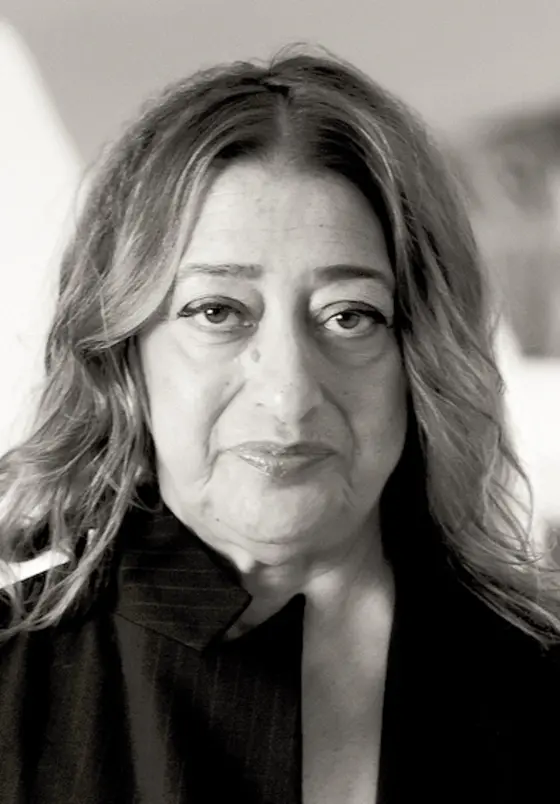
On March 22, 2004, the Pritzker Architecture Prize announced its 26th laureate. In the prize's entire history, no woman had ever won it. That changed with a single name: Zaha Hadid.
Born in Baghdad in 1950, Hadid was an Iraqi-British architect who had spent nearly two decades being celebrated in architectural journals and ignored by clients. Her competition-winning designs were called unbuildable. A jury made her re-compete for a project she had already won and then declined to build it anyway. Through all of it, she kept drawing, kept teaching, kept building the work on paper when no one would commission it in concrete.
The Pritzker jury, chaired by Lord Rothschild, recognized not a single iconic building but an entire body of work representing a fundamental shift in what architecture could be. She was 53 years old. She was the first woman to win the prize. She was also the first Muslim, and the first person of Iraqi or Arab origin, to receive it.
Frank Gehry, himself a Pritzker laureate and a juror that year, put it plainly: "Each project unfolds with new excitement and innovation." Juror and Harvard professor Jorge Silvetti added: "What she has achieved with her inimitable manipulation of walls, ground planes and roofs, with those transparent, interwoven and fluid spaces, are vivid proof that architecture as a fine art has not run out of steam."
Baghdad to London: A Different Kind of Beginning
Zaha Hadid grew up in a Baghdad that no longer exists. Her father, Mohammed Hadid, was a prominent politician and businessman, co-founder of the National Democratic Party, and later a cabinet minister. Her family was secular, progressive, and politically engaged. Education was not a question. Ambition was expected.
She studied mathematics at the American University of Beirut before moving to London in 1972 to attend the Architectural Association (AA). At the AA, she encountered the work of the Russian avant-garde, particularly Kazimir Malevich and the Suprematists, whose abstract geometric compositions would stay with her for life. Her graduation project, "Malevich's Tectonik," imagined a hotel on London's Hungerford Bridge using the formal vocabulary of Russian Constructivism. It was radical, fully formed, and unlike anything her classmates had produced.
After graduating in 1977, she joined the Office of Metropolitan Architecture (OMA), working under Rem Koolhaas and Elia Zenghelis, two of the most influential architects of the twentieth century. She founded her own practice, Zaha Hadid Architects, in 1979. Then came the years of drawing.
Fifteen Years of Winning and Building Nothing
For roughly fifteen years after founding her practice, Hadid built almost nothing. She won competitions. Her drawings were published in architecture journals internationally. Her formal vocabulary was described as unlike anything seen before. And clients, consistently, walked away.
Her 1983 competition win for The Peak, a leisure complex in Hong Kong, brought her the first major burst of international attention. The design was never built. The same fate met a series of significant competition wins through the late 1980s and early 1990s. The phrase used about her work, again and again, was "unbuildable." It was not a technical judgment. The Vitra Fire Station, completed in 1993, proved the structural ideas were entirely buildable. The word was a way of declining to commission her.
The Cardiff Bay Opera House controversy made the pattern explicit. In 1994, Hadid entered and won an international competition among 268 entrants to design a new opera house for Cardiff, Wales. The result was disputed so strongly, for reasons that she and critics connected to prejudice against her as an Arab woman from London, that the jury conducted an extraordinary measure: it re-ran the semi-final stage and required her to compete again. She won a second time. The project was still not built. The Millennium Commission declined to fund it. The Wales Millennium Centre was constructed in its place. Architecture critic Hugh Pearman later observed: "There was a lot of prejudice against who she was, and oddly enough, not just because she was of Iraqi origin and not just because she was a woman, but because she was from London."
Hadid's response to the Cardiff situation, and to the entire period, was characteristically direct: "My work is not within the accepted box. Maybe because I am a woman. Also an Arab. There was a certain prejudice about these things."
She kept drawing. "There are 360 degrees," she said, "so why stick to one?"
The Breakthrough: From Paper to Concrete
The Vitra Fire Station in Weil am Rhein, Germany, completed in 1993, ended the paper architect period. The furniture manufacturer Vitra commissioned Hadid to design a fire station for its campus, and what she produced was unlike any fire station anyone had ever seen. Intersecting concrete planes lean and converge at angles that appear to freeze the building mid-motion. The walls do not meet at right angles. The rooflines collide rather than rest. The whole structure looks like a single frame extracted from an action sequence, permanently suspended.
It was structurally sound. It was functionally viable. It was real. Skeptical clients could no longer point to technical impossibility. The question became whether they wanted to commission her.
The answer, outside the UK, increasingly became yes. Her 2003 Contemporary Arts Center in Cincinnati (originally the Rosenthal Center) was the first major American art museum designed by a woman architect. The New York Times architecture critic Herbert Muschamp called it "the most important American building to be completed since the Cold War." The building's signature gesture, which Hadid called the "urban carpet," folds the street level up into the lobby and continues as ramps through the gallery spaces, making the transition from sidewalk to museum feel like a single unbroken movement. The building makes you feel the city and the art as continuous rather than separate.
Cincinnati made her internationally famous. The Pritzker followed twelve months later.
Parametricism and the Mathematics of Islamic Geometry
The design philosophy Hadid developed with her longtime partner Patrik Schumacher is called parametricism. The core idea: every element of a building is in a defined computational relationship with every other element. Curves flow into surfaces. Surfaces unfurl into roofs. Structural rhythm follows mathematical rules. Change one parameter and the whole system adapts. The buildings look organic, but they are produced by rigorous algorithmic logic.
This approach has a resonance that is structural, not merely visual, with Islamic geometric design traditions. The intricate tiling and arabesque patterns that define classical Islamic architecture are themselves the products of mathematical algorithms: recursive geometric rules that generate infinite visual complexity from a finite set of instructions. The connection between traditional Islamic pattern-making and parametric design is a real one. Both are systems where local rules produce global coherence.
Hadid grew up in a city where Islamic geometry was part of the visual fabric of everyday life. Baghdad's mosques, its markets, its domestic architecture all carry the mathematical precision of that tradition. She described her own relationship to her Muslim heritage simply: "I am a Muslim who went to a nun's school, and for six years of my life, I crossed my heart. There was no difference between the Christians and the Muslims." Her family was progressive and secular, but Islamic culture was foundational, in Baghdad's architecture, its art, its ornament, and its mathematics.
Her design for a proposed mosque and community center in Strasbourg, though ultimately unbuilt, translated the call to prayer into undulating architectural forms, with the curvilinear flow of Arabic calligraphy informing the building's geometry directly. It was not decoration. It was structure.
What She Built After the Pritzker
The Pritzker opened commissions that had been closed for years. The buildings that followed are among the most recognized of the twenty-first century.
MAXXI, the National Museum of 21st Century Arts in Rome, opened in 2010 and won the RIBA Stirling Prize that year. Built into the existing fabric of a Roman neighborhood, it uses exposed concrete walls that twist and bend through the site, with skylights that pour natural light into gallery spaces that constantly shift orientation. Hadid's intention was not a neutral container for art but a building that participates actively in the experience of viewing it.
The London Aquatics Centre, designed for the 2012 Olympic Games, curves its roof in undulating waves drawn from the movement of water. With the temporary Olympic seating removed after the Games, the building's clean wave-form settled into its permanent identity as a public swimming facility. It is still in daily use.
The Heydar Aliyev Center in Baku, Azerbaijan, completed in 2013, may be her most globally recognized building. A single sweeping white surface rises from the ground, folds up into a roof, descends, and forms the building's entire skin without a single right angle anywhere. It challenged every convention of how a cultural institution could be organized geometrically, and it has appeared in more architecture photography than almost any building of its era.
She won a second Stirling Prize in 2011, for the Evelyn Grace Academy in Brixton, south London, a secondary school that uses its architectural drama to reframe what a school building can mean to its students. In 2012, Queen Elizabeth II appointed her a Dame Commander of the Order of the British Empire for services to architecture.
The End, and What She Left Behind
Zaha Hadid died on March 31, 2016, in Miami, from a heart attack following treatment for bronchitis. She was 65. In January 2016, two months before her death, RIBA had announced she would receive the Royal Gold Medal, the UK's highest architectural honor. She died before the formal ceremony. She was, and remains, the first solo woman to receive it.
She had said, in her later years, something that shifted her earlier resistance to the "woman architect" label. She had spent years insisting she was an architect, full stop, not a woman architect. But she came to see the designation differently: "I see the incredible amount of need from other women for reassurance that it could be done, so I don't mind that at all."
Zaha Hadid Architects continues under Patrik Schumacher's leadership with approximately 400 staff. Revenues have grown from around £35 million in 2013 to £69 million in recent years. The firm's completed post-2016 work includes the Morpheus Hotel in Macau, the Opus Tower in Dubai, and Beijing Daxing International Airport. The Zaha Hadid Foundation, managed by her family, has announced plans for a museum in her honor and a scholarship program specifically for the architectural education of Arab women.
The scholarship is a fitting final clause. She spent her career being told that her identity, her gender, her background, and her work were all reasons to exclude her. She won anyway. And she made sure the door she broke through would not close behind her.
Frequently Asked Questions
Was Zaha Hadid the first woman to win the Pritzker Architecture Prize?
Yes. Zaha Hadid won the Pritzker Architecture Prize on March 22, 2004, becoming the first woman ever to receive the award in its 26-year history. She was also the first Muslim and the first person of Iraqi or Arab origin to win it.
What is the Pritzker Architecture Prize?
The Pritzker Architecture Prize is the highest honor in architecture, often described as the field's equivalent of the Nobel Prize. It has been awarded annually since 1979 by the Hyatt Foundation. Past laureates include Frank Gehry, Renzo Piano, and Norman Foster.
What did Zaha Hadid mean by the "triple whammy"?
Hadid used the phrase to describe the compound discrimination she faced throughout her career. In her words: "It's a triple whammy: I'm a woman which is a problem to many people, I'm a foreigner, another problem, and I do work which is not normative, which is not what they expect." She also noted specifically that "being an Iraqi after the Gulf War didn't help," referring to the period after 1991 when British public attitudes toward Iraqis were particularly hostile.
What happened with the Cardiff Bay Opera House?
In 1994, Zaha Hadid won an international competition among 268 entrants to design the Cardiff Bay Opera House. The result was so contested that the jury re-ran the semi-final stage and required her to compete again. She won a second time. The project was still not built; the Millennium Commission declined to fund it. Critics and Hadid herself attributed the outcome partly to prejudice against her identity as an Arab woman working in Britain. The Wales Millennium Centre was built at the site instead.
How did Islamic geometry influence Zaha Hadid's architecture?
Hadid's mature design philosophy, called parametricism, uses computational algorithms to generate building forms in which every element relates to every other through defined mathematical parameters. This approach has a structural resonance with Islamic geometric design traditions, where intricate tiling and arabesque patterns are themselves products of recursive mathematical rules that generate infinite complexity from finite instructions. Hadid grew up in Baghdad, where Islamic geometry was part of the visual fabric of daily life, and she drew directly on those mathematical traditions in her work.